

Thank you Nora Lyn St. Clair, PJ Schuster, Jen Champion, Heather A Murphy, and many others for tuning into my live video! Join me for my next live video in the app.

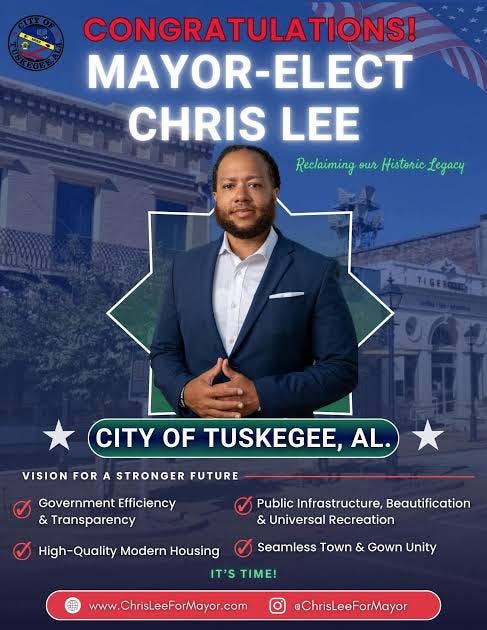
Huey P. Newton said power is the ability to define phenomena and make them act in a desired manner, and I told the students at Tuskegee University that quote governs my life, so let’s define the phenomenon real quick before somebody else defines it for us. In late September 2025, Frank “Chris” Lee beat the incumbent mayor of Tuskegee, Alabama in a runoff by 1,002 votes to 929, a margin of 73 votes, and he credits the students of Tuskegee University for showing up, and when I sat on that livestream and looked at the room, the mayor said it out loud, we probably got that many people in this room right now. Seventy three people. Like, that’s not a statistic, kinfolks, that’s a classroom, that’s a step show, that’s the line at the cafe on a Tuesday, and that classroom decided who runs the city.
Most of y’all were taught to treat the local race like it don’t count, so let me say it the way I said it on stream. I think it’s a part of the intelligent design to make it where we always sensationalizing the national federal races and make it where we view the local races as the meaningless games. For us that watch the NBA, we know it’s like 82 games, and most of us don’t give a damn about the 82 games, we only care about if you’re going to make the playoffs. Then we apply that same sports culture to politics and wonder why we alienated from how our own communities is ran. Ahh, but here’s the part they don’t put on the poster: Tuskegee is the place where the state of Alabama proved, in writing, that it understood the small games better than we did. In 1957 the legislature took a square city and redrew it into a figure with 28 sides to cut Black voters out of the municipal elections, and in 2026 the legislature took the congressional district Tuskegee sits in and redrew it from roughly 48 percent Black voting age population to 40 percent. Same pen, different century, same intelligent design.
This is about a city that was born from a vote, carved up over a vote, and is now being told again that its vote is a rounding error. It’s also a pack about what happens after the vote, because I said something in that room that I need to stand on: I’m rocking with Mayor Lee, hell yeah I am, and if he don’t deliver what he said he would, y’all should be on his helmet. Two things can be true.I. A City Born From a Vote
Before there was a Tuskegee Institute there was a deal, and the deal was electoral. In 1880, Lewis Adams, a formerly enslaved tinsmith and one of the most respected Black men in Macon County, sat down with two white Democratic candidates, W. F. Foster and Arthur L. Brooks, and made them an offer that every organizer in this room should study: I can deliver the Black vote in Macon County, what will you deliver back. Foster and Brooks won, and in February 1881 the Alabama legislature passed the act creating a normal school for Black teachers in Tuskegee with a $2,000 annual appropriation for salaries. Booker T. Washington arrived that summer and opened the school on July 4, 1881.
Sit with that, because it means the most famous Black school in the South was not a gift, it was a receipt. Lewis Adams understood in 1880 what I was trying to explain on stream in 2026, that politics is who gets what, when, where, and how, a definition I took from my own college coursework by way of Harold Lasswell, and that the vote is a currency you spend for something specific. Lewis Adams did not have a parasocial relationship with Foster. He had a contract.
Crazy how the state has honored that contract ever since in the smallest possible font. The original appropriation was $2,000 a year. The appropriation bill for fiscal year 2026 sends Tuskegee University $15,816,579 from the Education Trust Fund, and the bill’s own text explains that Tuskegee’s relationship to the state is unique, that the state holds seats on the Tuskegee board and the State Superintendent of Education sits as an ex officio voting member, and that because Tuskegee is both private and state related it should not be funded the way the state’s public universities are funded. Hold that sentence in your pocket. We are coming back to it with a calculator.
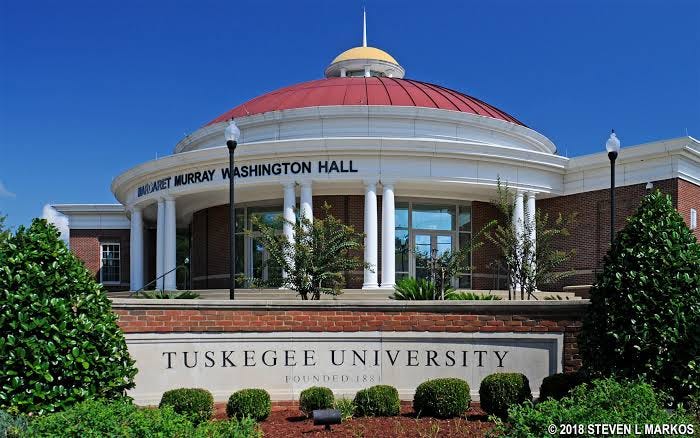
II. Twenty Eight Sides
By the 1950s the Black residents of Tuskegee had turned the institute into the most educated Black electorate in the Deep South, and the Tuskegee Civic Association, led by the sociologist Charles G. Gomillion, spent years pushing Black faculty, staff, and townspeople through a Macon County registration board that met rarely and rejected often. As the registered Black vote inside city limits climbed toward 400, the white political class did the math, and they did not like the math.
So in 1957 state Senator Sam Engelhardt, who also chaired the White Citizens Councils of Alabama, pushed Act 140 through the legislature. Act 140 redrew the boundaries of Tuskegee from a square into a 28 sided figure that, by the plaintiffs’ allegations, removed all but four or five of the roughly 400 Black voters from the city while removing not a single white voter. The institute itself ended up outside the city it built. The Tuskegee Civic Association answered with a selective buying campaign, a boycott of white merchants in the new, whiter downtown, and with a lawsuit argued by Fred Gray, the same Fred Gray who represented Rosa Parks and would later represent the men of the syphilis study.
On November 14, 1960, the Supreme Court decided Gomillion v. Lightfoot, 364 U.S. 339, and Justice Felix Frankfurter, who had spent years telling the Court to stay out of the “political thicket” of districting, wrote that the state could not use its power over municipal lines as an instrument to fence Black citizens out of the vote. The 28 sided city was struck down. Gomillion is the hinge case that opened the door to Baker v. Carr two years later and to the whole architecture of voting rights litigation that followed.
This means the folks who tell college students that districting is boring are wrong. Districting is the oldest weapon in the Tuskegee story, and the people who drew Act 140 were not confused about what they were doing. They were small games specialists.
III. Same Pen, Different Century
Let’s run the 2026 receipts in order, because this is the part that’s on your ballot November 3.
In 2023, in Allen v. Milligan, the Supreme Court upheld a lower court order finding that Alabama’s congressional map likely diluted Black voting power and required a second district where Black voters had a real opportunity to elect their candidate. The legislature drew a second map that still did not comply, and a federal panel appointed a special master who drew a new 2nd District stretching from Mobile through Montgomery and the Black Belt to the Georgia line, a district that for the first time pulled Tuskegee and Macon County out of the bottom of a Republican district run from Anniston. In 2024 Shomari Figures won that seat with 54.6 percent of the vote, and Alabama sent two Black representatives to Congress for the first time in its history.
Then came Louisiana v. Callais on April 29, 2026, which gutted the race conscious remedy under Section 2 of the Voting Rights Act. Gov. Kay Ivey, who had said she opposed redistricting before the 2026 elections, called a special session for May 4. The legislature went back to its 2023 lines. The Supreme Court then released Alabama from the court ordered map, the state postponed the primaries for four districts, and on August 11 Republicans nominated state Rep. Rhett Marques, endorsed by Trump, to take on Figures in a district where the Black voting age population drops from 48 percent to 40 percent and where Trump would have won by 14 points in 2024. The Cook Political Report moved the race to Lean Republican in June. Sabato’s Crystal Ball moved it from Likely Republican to Leans Republican in September, and the reason they gave is the whole sermon: Black turnout could be relatively strong across the South partly in response to Callais itself.
So when the mayor stood up and said that if you live in Tuskegee and change your registration you can have a direct impact, he was not hyping, he was reading the forecast. Then he said the line that every student in that room should tattoo on the back of their hand: they are not counting your votes, they have already factored out that you all don’t care about congressional elections, you all live in Georgia, Louisiana, you don’t pay attention. The map was drawn on the assumption of your absence. Crazy how a 40 percent district is “safe” only if the 18 to 22 year olds sitting inside it keep acting like guests.
Shout out to the student moderator who brought numbers to that conversation, because that’s research over mesearch in practice, and we gotta tighten the numbers up so nobody can shuck and jive around them. The district Figures won in 2024 went for him 54.6 to 45.4. The new lines would have gone for Trump by 14. That’s the swing the legislature bought with a pen. The moderator was also right that the 2024 results inside Macon County are lopsided Democratic, and the mayor clarified the arithmetic better than any consultant could: Figures is going to win Tuskegee by a huge percentage either way, but 3,000 votes versus 10,000 votes out of Tuskegee is what moves the districtwide number from 46 to 51. The percentage is not the weapon. The raw count is.
IV. The Small Games Decide the Playoffs
Apply Guinier here. In The Tyranny of the Majority (1994), Lani Guinier described voting rights in three generations. The first generation was access, the fight to get on the rolls at all, the fight the Tuskegee Civic Association fought at a registration board that barely opened its doors. The second generation was dilution, the fight over how lines are drawn so that Black votes are packed into one district or cracked across several until they are “wasted,” which is Act 140 in 1957 and the 2026 redraw both. The third generation, the one most people never get to, is governance, the question of what Black voters actually get once their candidate is seated, whether the representative stays accountable to the people who sent them or becomes, in Guinier’s language, a role model with no leverage, one Black face in a room built to outvote them.
The mayor gave the clearest third generation example I’ve heard from an elected official. There are five members on the city council plus the mayor, and he said with four votes somebody could come in and change the name of Tuskegee if they wanted to. If the wrong people moved in and organized a voting bloc and got their four people elected, Tuskegee might change its identity. Most of y’all heard that as a warning about outsiders. I heard Guinier. That’s what a majoritarian system does, it hands the whole institution to whoever controls 50 percent plus one, which is exactly why the folks who drew Act 140 wanted a city council without Black voters, and why the people who redrew AL 02 wanted a congressional seat that Black Belt turnout alone can’t carry.
Lasswell gives you the definition, Guinier gives you the stages, and the student in the room gave you the question: how do we encourage people who think their vote doesn’t matter. Here’s what I said and I’ma stand on it. Our vote matters so much that it impacts whether we get salmonella in our lettuce. Our vote matters so much that it impacts whether y’all are able to even learn about Booker T. Washington, or whether the country is able to learn about Carter G. Woodson. My grandma deserves to be able to afford insulin, so I got to figure out what policy is impacting the cost of insulin. Every single thing that happens to us, whether it’s my mama on drugs or people eating sleep for dinner or bombs blown up over Baghdad, there’s a policy and a policymaker, probably a lobbyist, probably a bureaucracy, probably an interest group behind it. They complicate politics in a way that causes voter apathy. We gotta simplify it.
Then I said the part I need everybody in the back to hear. A lot of us as Black people are used to being acted upon. We ain’t used to being the actors.
V. On His Helmet
This is where the third generation turns into a posture. We have too many parasocial relationships happening in politics. Does Chris Lee remind me of a cousin, an uncle, a brother? Yes. That’s not the capacity I was talking to him in. I was talking to him in the capacity of a public official, and after you vote for a person who gets in office, you got to put that magnifying glass on them, you got to act like the mama checking whether you did your chores. You told me you was going to do this. If you don’t do it, you getting grounded.
Charles Payne helps us name what the mayor already built. In I’ve Got the Light of Freedom, Payne distinguishes the mobilizing tradition, big events, big speeches, big turnout days, from the organizing tradition, the slow work of building people who can act for themselves long after the speaker leaves town. Apply Payne here. The 73 votes were mobilizing. The Tuskegee City Ambassador Program, which the mayor described as student led, with students in internships, students in blazers with the city seal, students bringing him problems like a 45 minute ambulance response to a medical emergency on campus, that’s organizing, and that’s the infrastructure that makes the helmet possible. You can’t hold a man accountable from the outside of a building you never walked into.
Then, to his credit, the mayor turned the helmet on himself. This position belongs to the people, he said, I’m just a vessel. Follow the money, he said, and he told them his political science professor taught him the real golden rule: whoever has the gold rules. He said he’s proud he didn’t have big donors pulling public strings, and he said he thought he was coming in with a magic wand and found out it takes replacing personnel, taking resistance, and time. Two things can be true. That transparency is real, and it’s also the exact moment the students should write his promises down with a date next to them, because a vessel that nobody checks becomes a bucket with a hole in it.
Here’s the receipt that shows what the third generation looks like when it works. When the company running the dialysis center in Tuskegee decided to shut down the local operation and send patients to surrounding areas, the mayor said Figures came down, they pulled up on the company, and Figures called the higher ups to make sure the company did what it said it would do. Somebody please tell me what a 14 point Trump district does for a dialysis patient in Macon County. The orange man up in D.C., his ability to do what he wants to us these last two years is going to be predicated off the local elections. Keep that in mind in these midterms, because these local elections could be decided by five votes, 100 votes, 70 votes.
VI. A Town With a College, a College Town, and a Calculator
I asked the mayor to break down the difference between Auburn, a college town, and Tuskegee, a town with a college, for the folks who don’t know Alabama, and he started with the obvious: Tuskegee is about 95 percent Black. He said the federal posture toward the city has been benign neglect, represented for decades by people the community did not vote for, so what motivation did they have to let infrastructure money trickle down. He said Auburn 40 years ago was in worse shape than people remember and took advantage of what he called strategic favor. Then he said he didn’t have the exact numbers. Bet. Let me hand him the calculator.
For fiscal year 2026, the Auburn University System is appropriated $436.3 million from the Education Trust Fund, out of roughly $1.95 billion in total operating appropriations. Tuskegee University is appropriated $15.8 million. Then the legislature passed a supplemental from the Advancement and Technology Fund this spring that sends Auburn University $30.6 million and Tuskegee University $990,360. That’s not a gap, that’s a canyon with a gift shop.
Ahh, but it gets more specific. Tuskegee is an 1890 land grant university, and land grant funding runs on a match: Washington sends formula money for agricultural research and extension, and the state is supposed to match it. On March 6, 2024, Senators Stewart and Beasley introduced SB 189, which would have required $475,470,075 from the Education Trust Fund to Tuskegee over ten years to make the university whole for the state match it never got from 1987 through 2020, calculated against what Tuskegee would have received if its per student state funding matched Alabama’s 1862 land grant university. That bill was read once, referred to the Senate Finance and Taxation Education Committee, and has sat there ever since. Meanwhile the annual Tuskegee appropriation earmarks “at least $2,000,000” for the agricultural research and extension state match, and somebody in Montgomery calls that generosity.
Whitey on the Moon, kinfolks. The state found $30.6 million in one supplemental for one Auburn campus. The state could not find the first dollar of a $475 million debt it owes the school it created by statute in 1881 off a Black vote. When the mayor says “if I had one wish, it probably would be to bring a hospital,” and when he says the building we were sitting in used to be a hospital where Black babies were born to Black nurses and Black doctors, understand that the absence is not an accident of the market. It’s a budget line. The mayor said it himself: a hospital is a business, it shouldn’t be like that, but in this capitalistic system somebody’s got to pay for the doctors and the MRI machines. Just admit the state already decided who that somebody is.
This also proves the mayor’s other point, the one he made almost in passing: if you don’t own it, then you don’t have control over it. He said the city and Black developers have been quietly acquiring property so the wrong people can’t get their hands on it the way the wrong people could get their hands on four council seats. I’m with it, and I’m also going to keep that helmet handy, because I told that room the other half of what I’ve seen across Alabama: a lot of city municipals and mayors sell out their constituents for outside profits. Y’all ain’t got time for that.
VII. Sammy Younge Was Registering Voters Too
Apply Williamson Lott here. In Jim Crow Campus, Joy Ann Williamson Lott shows that Southern state governments treated higher education, Black and white, as an instrument for maintaining the racial order, using appropriations, board seats, and loyalty pressure to keep campuses in line, while students kept turning those same campuses into bases for movement work. Tuskegee is a textbook case with the textbook written into the appropriation bill. The state funds Tuskegee one year at a time, through a standalone bill that must pass every session, with state appointees on the board and an operations plan and audited statements required before a dollar is released. That’s not just oversight. That’s a leash with a reporting requirement.
So when the mayor said the university is “private, but quasi public when it comes to state funding,” he was naming the exact mechanism Williamson Lott studies. Then when he said that for years the campus and the local government “operated in silos,” maybe because the mayor didn’t get along with the president at the time, apply Eddie Cole. In The Campus Color Line, Cole shows that college presidents have always been political actors, managing what their campuses can say and do on race to protect funding and standing with the state. A university president who depends on an annual appropriation from a supermajority legislature has every incentive to keep the campus quiet and the city at arm’s length, and a city that depends on that campus as its economic base, the mayor’s words, “you all are the economic base of this city,” pays the price for that distance in ambulances and potholes.
Now let me tell the students who they are standing on, because this is the part the brochure leaves out. On January 3, 1966, Sammy Younge Jr., a Tuskegee Institute student and Navy veteran who worked with SNCC and the Tuskegee Institute Advancement League registering Black voters in Macon County, was shot and killed by a white gas station attendant after he tried to use a whites only restroom. James Forman called him the first Black college student to die in the Black liberation movement. Days later, SNCC issued its statement opposing the war in Vietnam and named Sammy Younge in it, connecting a Black veteran killed at home for demanding a toilet to a government asking Black men to die abroad. An all white jury in Lee County acquitted the man who killed him. Tuskegee students marched downtown, and that same year Macon County elected Lucius Amerson sheriff, the first Black sheriff in the South since Reconstruction. Six years later the city elected Johnny Ford its first Black mayor.
That’s who the 73 votes belong to. When the mayor told students to put Rockefeller Hall and their room number on the registration form instead of the generic campus address, because a form with the wrong address gets thrown out and nobody calls you back, and when he said out of state students can’t register online in Alabama and have to fill out a paper form with a pen, which he joked half of y’all haven’t touched in years, understand that every one of those barriers is a descendant of the board that met twice a month and rejected Tuskegee faculty with PhDs. The paperwork is the registration board now. Fill it out like Sammy Younge is grading it.
Here’s what I told the student who asked for one action item besides registering. Ask yourself what you want in the next two semesters, and who you need to talk to, what you need to engage, what you need to do to get it. Excuse my French, if the shit don’t matter in five years, don’t do it. I’m not the person I was when I was in y’all’s seat in 2012, 2013. I spent time learning how the world works and figuring out how to get what I wanted from it based on the tools I had access to. Right now we got a lot of us lost in the sauce for quick results, and because so many of us are lost in the sauce, we don’t recognize that most things happen over time and require information before you respond. Before you act, collect some data, do some research, understand the who, what, when, where, and how. Then act.
The last thing on education. The young man who described tutoring a fifth grader using first and second grade worksheets asked how students leave a lasting impact when they can’t be there 24/7. The mayor told him the truth: he has watched kids he drove home every day go on to do great things, and he has watched some of them get killed, including the homicide near Howard Road the day after students were there tutoring. Those two facts sit side by side in the same city that holds a world class research university, and that is the education problem in one sentence. The answers are literally inside these gates, the mayor said, the architecture students who could draw plans for residents who can’t afford an architect, the professors who want to turn the city’s waste into fuel. The gates have just been closed from both sides.
VIII. The Women Who Ran the Clipboard
Rosa Parks was born in Tuskegee on February 4, 1913. Most of the country remembers her for a seat. Danielle McGuire’s At the Dark End of the Street remembers her for a clipboard. In 1944, a decade before the bus, Parks was sent by the Montgomery NAACP to Abbeville, in Henry County, to investigate the gang rape of Recy Taylor, a young Black mother and sharecropper, by a group of white men who were never convicted. McGuire argues that Black women’s organizing against sexual violence, the fight for bodily integrity, is the buried root of the Alabama movement, and that the movement’s public memory turned a network of tough, strategic women into a single tired seamstress.
That same erasure was sitting right in front of us on the stream. The questions that drove the policy conversation came from women like Deirdre Newcomb, a double major in aerospace engineering and political science and a member of the NAACP, who asked for one action item for every young person listening. The person who closed the event, who told the room the forms were in the back and that it takes less than three minutes, was the NAACP’s press and publicity chair, a Black woman whose name the transcript didn’t even catch. The mayor credited the Greeks, the campus NAACP, and the organizations with clipboards. That’s correct, and it’s also how the story gets told every time, with the men at the mic and the women at the folding table, and then fifty years later the folding table is where the history actually happened.
Now take the lens from the ballot to the body, because the mayor and the students kept circling the same three things: no hospital, a dialysis center the company tried to close, and no mental health facility. Apply Harriet Washington. In Medical Apartheid, Washington documents the Tuskegee study, run by the U.S. Public Health Service from 1932 to 1972 on roughly 600 Black men in Macon County, about 399 with syphilis and about 201 without, who were never told they had the disease and were kept from penicillin even after it became the standard cure in the late 1940s. It’s remembered as a study of men. It was also a study that let the disease reach their wives and children, which is why the federal health benefits program created after Fred Gray’s lawsuit was later extended to wives, widows, and offspring. The study ended only after Jean Heller’s AP story in July 1972. Clinton apologized in 1997.
Washington’s point is that medical abuse is not only a scandal, it is a structure, and the structure shows up as absence. When the mayor says the city has no hospital, when kidney failure hits Black Americans at several times the rate of white Americans and the dialysis provider decides Tuskegee isn’t worth the overhead, when a student asks about mental health and the mayor says plainly there’s no facility here and that the root is often poverty, the bodies carrying that absence are disproportionately Black women. Black women are the caregivers who drive the dialysis patient to the next county, the mothers taking off work, the grandmothers whose insulin I was talking about. Intersectionality is not a vibe here. It’s a mileage log.
Then flip the gender lens to the young men in the room, because the betting conversation was about them. The gambling apps market hardest to young men, and they praying on y’all. They hope instead of sending your Pell Grant money to your mama and daddy, you put $5 on a player getting this many dunks, $10 that some Auburn player makes this tackle. Watch a football game or a basketball game and count how long it takes before they encourage you to bet. The same economy that won’t fund a hospital is spending millions to make sure a 19 year old in Rockefeller Hall has a sportsbook in his pocket.
IX. They Sold Us Dog Racing to Keep the Schools Open
The mayor brought up a race nobody thinks about, a seat on the Macon County Racing Commission, and he said it’s the entity that oversees the money from VictoryLand in Shorter, which started as greyhound racing and is basically a casino now. He’s right that it’s not sexy and he’s right that it matters, and the history explains why.
According to former Mayor Johnny Ford’s own account, in December 1982 the Macon County Board of Education announced that schools would be closing for lack of funding, and that was the beginning of dog racing in Macon County. VictoryLand opened in 1984. At its peak around 2010 it employed roughly 2,500 people. Then the state raided it, seized its electronic bingo machines and cash, closed it for years, fought it all the way to the Alabama Supreme Court, and left Macon County with the bill while, Macon County leaders argued, similar operations elsewhere kept running. Live racing ended in 2011. Today the floor runs historical horse racing machines.
Look at what that sequence teaches. A Black Belt county was left so underfunded that gambling got sold to it as school money, then the state treated that same gambling as a crime when Macon County did it. Every accusation is a confession. Now in 2026 a super PAC backed by DraftKings and FanDuel, the American Conservative Fund, spent more than $9.3 million in Alabama’s Republican primaries backing 17 legislative candidates and winning at least 12, shaping the next legislature before it ever votes on lottery or sports betting. Alabama still has no legal sports betting, yet prediction markets like Kalshi operate in the state under federal commodities regulation, and an Alabama resident filed a class action in January 2026 alleging Kalshi has been operating illegally under the state’s gambling laws.
To be precise, because precision protects us: the Racing Commission oversees the racetrack license, not Kalshi or Polymarket or PrizePicks. My point on stream was that the technology is moving faster than our policing and our policies, and eventually somebody at the county level is going to have to account for the betting that happens inside the county on apps nobody locally licenses. Me, Deontay, and a few other Black folks with platforms are very conscious, no pun intended, of how the gambling industry preys on Black people. Connect the dots is all I want to do. Connect the dots.
X. Cast Down Your Bucket, Just Not on Your Neighbor’s Land
Now let me hand y’all something to build with, because I did not come to Tuskegee to tell students they’re doomed. Apply Imani Perry. In South to America, Perry argues that the South is not America’s embarrassing exception but its key, the place where you can read the whole country most clearly, and also a place of extraordinary Black beauty, ingenuity, and home. She writes the South as somewhere you can choose, not just escape.
That’s the mayor’s thesis, and I want to give him his flowers for it. People think he wants to be governor and then go to president, and he told the room he doesn’t, that Tuskegee is the biggest platform where he can lead Black America, the same way Booker T. Washington, George Washington Carver, the Tuskegee Airmen, and Lionel Richie and the Commodores did from the same ground. He told students they can work remotely from Tuskegee, get a few acres instead of a little bitty one bedroom, start a business inside the student economy, come back for more than homecoming, and tune into council meetings. He quoted Washington’s “cast down your bucket where you are” to the young man from rural Louisiana deciding whether to register in Alabama, and he was honest that it’s election by election, which is why he told the story of switching his own registration to Virginia as a Hampton student in 2008 and feeling like his class helped carry the state for Obama.
Two things can be true. Perry’s South also remembers that “cast down your bucket” was the Atlanta Compromise speech of 1895, and Du Bois spent the next decade arguing that Washington’s bucket came with a promise not to ask for the vote. The students who cast down their buckets in Tuskegee in 2025 did it at the ballot box, which is the part of the bucket Washington’s critics said he left in the well.
There’s one more two things can be true I owe this room. The mayor told students about buying property at county tax sales, the lists of properties with unpaid taxes the revenue office publishes every spring, and he was clear that most of the time the owners come back and redeem. That’s real wealth advice and it’s also a door that has swung the other way in the Black Belt for a century, because tax sales are one of the ways Black families lost land, especially heirs property passed down without a clear title. So yes, buy the lot. Also check whose grandmama it belonged to, and if you can help a family keep it instead, that’s an investment too. Ownership that comes from your neighbor’s eviction is just Auburn with a Tuskegee address.
Power in Closing
See, Guinier reminds us that voting rights come in generations, first the right to cast the ballot, then the right to have it count inside a fair line, then the right to have it govern, and that a city redrawn into 28 sides in 1957 and a district redrawn from 48 percent to 40 percent in 2026 are the same second generation attack wearing a different suit. Williamson Lott teaches us that the state has always tried to manage Black campuses through the purse and the board seat, and that the students who refused to be managed, from Sammy Younge Jr. to the 73 votes in that room, are the reason the campus means anything at all.
So define the phenomenon. The phenomenon is a map drawn on the assumption that you will not show up. Make it act in a desired manner. The forms are in the back. Use your dorm and your room number. Write legibly. Vote November 3. Then get on the helmet of everybody you voted for, including the folks you love.
I put blood, sweat, and tears into creating this platform and then making sure that communities like Tuskegee, Alabama is accounted for. You feel me? Make sure that it got depth, breadth, perspective, visibility over there.
Education Is Elevation, but power. How do you define power?
5 Key Takeaways
Tuskegee was born from a vote. Lewis Adams traded Macon County’s Black vote for a state funded school in 1880, and the school opened July 4, 1881. The vote has always been a contract, not a vibe.
Districting is the oldest weapon in the Tuskegee story. Act 140 turned the city into a 28 sided figure in 1957, Gomillion v. Lightfoot struck it down in 1960, and the 2026 redraw cut AL 02’s Black voting age population from 48 to 40 percent after Callais.
The raw count beats the percentage. Figures will win Tuskegee either way. Whether Tuskegee delivers 3,000 votes or 10,000 is what moves the districtwide number, and the map was drawn assuming students won’t show up.
The funding gap is a budget decision. Auburn’s system gets $436.3 million from the Education Trust Fund for FY 2026 to Tuskegee’s $15.8 million, and a $475 million land grant match repayment bill has sat in committee since March 2024.
Voting is the entry point, not the finish line. Keep the receipts, keep the dates, and stay on the helmet of every official you elected, including the ones who feel like family.
Paid Subscriber Ask
This piece exists because somebody has to fill the critical void left by the retreat of public education media, and I’m doing it from the ground, from Tuskegee’s campus to your phone, with no corporate backing and no institutional cover. Black male educators are less than 2% of this profession, I am that 2%, and every pack like this one takes hours of archive work, case law, budget documents, and fact checking so you can walk into any room with receipts. If this helped you understand why 73 votes matter, why a 28 sided city matters, and why a $475 million debt sitting in committee matters, become a paid subscriber today. Fund the fortress or watch the erasure continue.
WORKS CITED/RELATED READINGS
Cole, Eddie R. The Campus Color Line: College Presidents and the Struggle for Black Freedom. Princeton University Press, 2020.
Forman, James. Sammy Younge, Jr.: The First Black College Student to Die in the Black Liberation Movement. Grove Press, 1968.
Guinier, Lani. The Tyranny of the Majority: Fundamental Fairness in Representative Democracy. Free Press, 1994.
Lasswell, Harold D. Politics: Who Gets What, When, How. 1936.
McGuire, Danielle L. At the Dark End of the Street: Black Women, Rape, and Resistance. Knopf, 2010.1819 News, “Tuskegee incumbent Haygood defeated by Lee in mayoral runoff.” https://1819news.com/news/item/tuskegee-incumbent-haygood-defeated-by-lee-in-mayoral-runoff
Alabama Political Reporter, “Can Shomari Figures win reelection after redistricting?” July 15, 2026. https://www.alreporter.com/2026/07/15/can-shomari-figures-win-reelection-after-redistricting/
Alabama Political Reporter, “Race rater narrows GOP edge in Alabama’s 2nd Congressional District,” Sept 11, 2026. https://www.alreporter.com/2026/09/11/race-rater-narrows-gop-edge-in-alabamas-2nd-congressional-district/
Alabama Political Reporter, “DraftKings, FanDuel backed PAC scores big wins in Alabama primaries,” May 26, 2026. https://www.alreporter.com/2026/05/26/draftkings-fanduel-backed-pac-scores-big-wins-in-alabama-primaries/
Perry, Imani. South to America: A Journey Below the Mason Dixon to Understand the Soul of a Nation. Ecco, 2022.
Washington, Harriet A. Medical Apartheid: The Dark History of Medical Experimentation on Black Americans from Colonial Times to the Present. Doubleday, 2006.
Williamson Lott, Joy Ann. Jim Crow Campus: Higher Education and the Struggle for a New Southern Social Order. Teachers College Press, 2018.
Further reading: Blain, Keisha N. Until I Am Free (2021); Gray, Fred D. Bus Ride to Justice (1995); Jeffries, Hasan Kwame. Bloody Lowndes (2009).


