

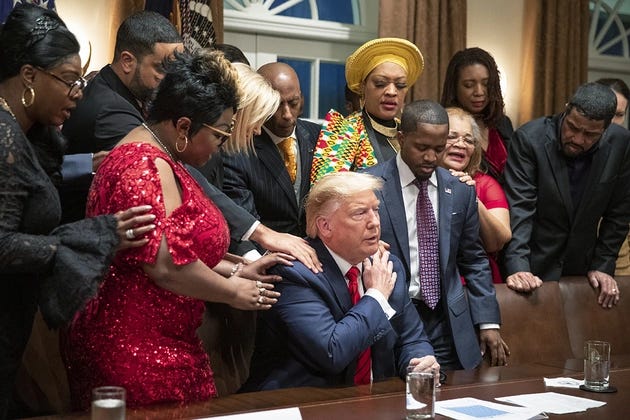
“African Americans built this nation. You built this nation. You know, you’re just starting to get real credit for that. We all built it. But you were such a massive part of it, bigger than you were given credit for. Does that make sense?”
That’s what his lord and savior Dukie Donald said. That is not a paraphrase and it is not a meme. That is the White House transcript from October 4, 2019, the Young Black Leadership Summit, Candace Owens in the room, the President of the United States telling a ballroom full of Black conservatives that our people built this country and that we are only now getting credit for it. Now let’s get back to this man making these historical claims.
Jeff Mead, two million plus followers on TikTok, been running a whole series on Abdul El Sayed since El Sayed won the Democratic nomination for Senate in Michigan, decided the way to get El Sayed was to get us. El Sayed said we built this country. Mead’s response was a number. In 1860, he says, only 10 to 12 percent of the GNP came from slave labor, the highest documented year was 16 percent, so the vast majority of how this country was built was not slave labor, so when you hear somebody say this country was built on the backs of slaves, no it wasn’t, and El Sayed is just pandering for the Black vote.
What y’all seen right there is an example of when you think deeply about shallow shit, you start making ahistorical claims. So let me do what I do. Historical context first, then the present, then the two things that can be true, then the receipts on the pandering charge, because that one is going to boomerang on him so hard it’s going to knock the hat off his head.
The Number Is a Twentieth Century Instrument Retrofitted Onto a Nineteenth Century Crime
Start with the word he leaned on. GNP. Gross National Product. Mead told his audience to think of it like GDP today. Fine. Here is what he did not tell them: nobody in 1860 was computing a GNP. The concept did not exist. Simon Kuznets built the first national income accounts for the United States Senate in 1934, in the middle of the Depression, because the federal government needed a single number to describe an economy it was trying to rescue. Everything anybody says about the GNP of 1860 is a modern reconstruction, most of it tracing back to the economic historian Robert Gallman, who spent decades in the 1960s and 1970s back filling estimates from census returns and farm output records so that economists could argue about the antebellum economy in twentieth century units.
That matters because the specific numbers Mead recited line up with one paper. Paul Rhode, an economist at the University of Michigan, published “What Fraction of Antebellum US National Product Did the Enslaved Produce?” in Explorations in Economic History in 2024. Rhode’s bottom line is that the enslaved produced roughly the same share of GNP as their share of the population. That population share was 16.8 percent in 1800, falling to 12.6 percent in 1860 as European immigration poured into the North. So the “highest documented” year Mead is bragging about is not some anomaly at the peak of King Cotton. It is 1800, when the enslaved were a bigger slice of the country. The number tracks the headcount. The number was always going to track the headcount, because the number was built out of the headcount.
Sit with what Rhode’s finding actually says, because Mead read it upside down. Four million people who were paid nothing, owned nothing, could not sell their labor to the highest bidder, could not move to the city, could not go to school, could not patent a cotton gin, could not buy the land they cleared, produced output at the same rate as the free population of the wealthiest republic on earth. That is not evidence that slavery was marginal. That is evidence of the most extractive labor system in the hemisphere running at full population efficiency while its workers were held as property.
Then there is the thing the flow number cannot see at all. GNP is a flow. It measures what got produced in a year. “Built” is a stock word. It asks what got accumulated, what got financed, what got founded. Look at the stock. By 1860 the roughly four million enslaved people in the United States were carried on the books at somewhere between three and four billion dollars. Roger Ransom, Richard Sutch, and Steven Deyle have all run the arithmetic, and the conclusion is the same each time: enslaved human beings were the largest single financial asset in the country, worth more than all the railroads and all the factories in the United States combined. The average slaveholder held close to two thirds of his wealth in people, not land. The richest counties per capita in the nation in 1860 were not in Massachusetts. They were in the Mississippi and Louisiana cotton belt. When Mead says the vast majority of how this country was built was not slave labor, he is describing one year’s output and calling it a foundation.
Jennifer Morgan’s Reckoning with Slavery shows that the modern habit of thinking about Black people as quantities, as a percentage, as a headcount, as a fraction of an output table, did not arrive after slavery to evaluate it. It arrived with slavery to run it. The ship manifests, the insurance schedules, the bills of lading, the appraisals that listed a woman and her “increase,” those were the first national accounts. They counted us before they counted the cotton. So when a Black man stands in front of two million people and uses a percentage as a verdict on whether his own ancestors count, he is not doing economics. He is doing the ledger’s job for it, for free, which is a kind of poetry if you think about it, because free is exactly the rate the ledger always preferred.
King Cotton Was Not a Metaphor, It Was a Senate Speech
Now the archive, because the archive is where this man gets embarrassed by dead white men.
James Henry Hammond, senator from South Carolina, stood on the floor of the United States Senate on March 4, 1858, and told the North that if the South stopped shipping cotton for three years, England would topple and carry the whole civilized world down with her. His line was “Cotton is king.” He was not describing 5 percent of anything. He was describing leverage. Two years later E. N. Elliott put together a whole volume of the pro slavery intelligentsia under the title Cotton Is King, and Pro Slavery Arguments, building on David Christy’s 1855 tract of the same name. This is the book I held up. This is the book those Confederate flag toting folks that want to keep us on the plantation wrote about themselves. They were not saying slavery was a minor input. They were saying slavery was the load bearing wall of the Atlantic economy, and they were saying it to justify seceding from the country Mead thinks they barely helped build.
Brian Schoen’s The Fragile Fabric of Union (2009) traces exactly how that confidence worked. The Deep South believed the cotton trade was essential to the European economy because for most of the antebellum period it was, and that belief is what gave the planter class the nerve to walk out of the Union and expect Britain and France to come running. Sven Beckert’s Empire of Cotton (2014) puts the global frame on it: by 1860 raw cotton was 61 percent of the value of everything the United States exported, and it was picked by enslaved hands. Cotton was the raw material that fed the mills of Lancashire and Lowell, and the mills of Lancashire and Lowell were the Industrial Revolution. That is the “central rise of modern global capitalism” argument, and you do not have to accept every number in the New History of Capitalism to accept that the men who ran the cotton economy said, in print, on the record, that they were the reason the modern world had a textile industry.
Now here is where I am going to be more honest than Mead was, because Research over MeSearch means the other side gets its best day in court. Economists Alan Olmstead and Paul Rhode have spent years arguing that the New History of Capitalism overreached. Edward Baptist’s claim in The Half Has Never Been Told that cotton accounted for almost half of American economic activity in 1836 was bad accounting, double counting inputs as outputs, and it has been roundly criticized. Cotton exports themselves were under 5 percent of GDP for most of the antebellum period. Corn, grown mostly by free labor, was worth more than cotton in most years. Gavin Wright, in a 2022 Journal of Economic Perspectives piece, argues that slavery was not necessary for cotton production and that the slave South was, if anything, a drag on the region’s long term development. Mark Stelzner and Sven Beckert answered with a 2024 paper in the Economic History Review using a different method that credits enslaved workers with a larger contribution to output and especially to growth. This is a live fight among serious people. I am not going to pretend it isn’t.
Two things can be true. It can be true that Baptist’s half of the economy figure was wrong, and it can be true that Mead’s use of the corrected figure is a lie. The reason is that “how much of one year’s output” was never the question El Sayed was answering. The question was who built the country, and the country is not a year’s output. The country is a Constitution with a three fifths clause, a fugitive slave clause, and a twenty year protection for the international slave trade written into Article I. The country is a Capitol dome and a White House raised by enslaved workers hired out by their owners for five dollars a month, a fact Congress finally put on a plaque in Emancipation Hall in 2012. The country is a slave market at the foot of Wall Street, established by the city of New York in 1711, decades before there was a stock exchange to stand on the same corner. The country is Northern banks financing Southern plantations, Northern insurers writing policies on human cargo, Northern shipyards building the vessels, and Northern textile mills turning the cotton into the cloth that made New England rich. Cut the cotton out of that picture and you do not get 88 percent of a country. You get a different country, and the men who wrote Cotton Is King knew it, which is why they went to war over it.
Every Accusation Is a Confession: The Pandering Boomerang
So Abdul El Sayed is pandering towards the Black vote because he accurately said that we built this country. Let’s run the same standard on Mead’s own president and see what falls out.
When Donald Trump told the Young Black Leadership Summit in 2019 that African Americans built this nation, was he being real, or was he pandering? Because if he was being real, then Mead just called Trump a liar and a panderer on the same facts. Like, that’s the whole clip. That’s the accusation. If he was pandering, then why did Mead’s lord and savior create a plan called the Platinum Plan, rolled out in Atlanta on September 25, 2020, half a trillion dollars in promised capital access to Black communities, named like a rap album? Because, you know, Black folks like bling bling, huh? Why did he pardon Lil Wayne and Kodak Black on his way out the door in January 2021, and then pardon NBA YoungBoy in May 2025? Was that policy, or was that pandering? You don’t care about pandering, bro. You care about who is doing it. That is the tell. Mock quote him for a second: “iMa bE tHe PrInCiPlEd OnE aBoUt PaNdErInG” while his guy is handing out platinum plans and rapper pardons like Halloween candy.
Then there is the part Mead really does not want to hold. The president who said we built this nation in 2019 signed an executive order on March 27, 2025 titled “Restoring Truth and Sanity to American History,” assigned J. D. Vance to scrub “improper ideology” out of the Smithsonian, and by August of that year was posting on Truth Social that the museums are “OUT OF CONTROL” because “everything discussed is how horrible our Country is, how bad Slavery was.” In September 2025 the administration ordered the National Park Service to pull slavery interpretation from multiple parks, including the photograph of Peter’s scourged back. In July 2026 the White House Domestic Policy Council dropped a 162 page report calling the National Museum of American History “radical” for how it presents slavery, conquest, and exclusion, with the National Museum of African American History and Culture already in the review queue since August 2025. Crazy how the museum that had a Smithsonian panel overstating slavery’s share of the national product is the same museum the White House is now auditing for saying slavery was bad at all. The number Mead is using to shrink us is being deployed in Washington to erase us. Same playbook, two floors of the same building.
Whitey on the Moon beat, because y’all know I got one. The country is spending nine figures on America250 birthday programming, a Garden of American Heroes, and a lawyer led review of every slavery exhibit in the national museums, in the same fiscal year Mead is out here telling us we were a rounding error. If we were a rounding error, why does it cost this much to stop the museum from mentioning us?
The Schoolhouse Was Ours Before the Curriculum Was Theirs
Here is the part of “who built this country” that never makes the GNP table, because the GNP table does not have a row for who built the public school.
Apply Anderson here. James D. Anderson’s The Education of Blacks in the South, 1860 to 1935 documents that universal public education in the former Confederacy was not handed down by Northern philanthropists or Southern reformers. It was initiated by ex slaves. Freedpeople opened schools in churches and cabins before the Freedmen’s Bureau arrived, taxed themselves to pay teachers, and when Black men sat in the Reconstruction state legislatures from 1868 forward, they wrote universal, tax supported public schooling into the new Southern state constitutions for the first time in the region’s history. Du Bois said it plainly in Black Reconstruction in 1935: the public school system of the South is the creation of Black Reconstruction. White children in Mississippi got a free public education because Black legislators voted for one. Then Anderson tracks the second half of the story, how the Hampton and Tuskegee industrial model got funded by Northern money precisely to steer that Black demand for schooling into a curriculum that would not threaten the Southern labor order. Even the counter revolution had to build on top of what we built.
Craig Steven Wilder’s Ebony and Ivy runs the same argument up the ladder. Harvard, Yale, Brown, Columbia, Princeton, Penn, Georgetown: chartered, endowed, and in several cases physically constructed with slave trade money and enslaved labor. In 1838 the Maryland Jesuits sold 272 people south to keep Georgetown solvent. That is not a metaphor about “built.” That is a bill of sale with a university on the other end of it.
Now the present, and the reason this section has a Texas address. In 2015 a ninth grader in Pearland named Coby Burren texted his mother a photo from his McGraw Hill world geography textbook. The caption said the Atlantic slave trade brought millions of “workers” from Africa to Southern plantations. His mother, Roni Dean Burren, put it on Facebook, and McGraw Hill had to reprint. In 2023 Florida adopted standards instructing teachers that enslaved people developed skills that could be applied “for their personal benefit.” Mead’s twelve percent is the same move in a different font. The 2015 caption called us workers so the arithmetic would balance. The 2023 standard called bondage a job training program so the story would be uplifting. Mead calls us a small share of GNP so the country can be innocent. All three are the same sentence: they were here, they were minor, and the building would have gone up without them. The kids in Pearland and Tallahassee are the ones who pay for that sentence, because they are being taught a country in which the people who founded their public school system were a line item.
The Number Never Had a Row for the Womb
Intersectionality is the default, not the bonus round, and this one lands on Black women harder than anywhere else, because the ledger had a special column for them.
Daina Ramey Berry’s The Price for Their Pound of Flesh follows the appraisal of enslaved people from before birth to after death. Enslaved women were valued for labor and for “future increase,” which is why a woman of childbearing age could be appraised above a man of the same age and strength. That valuation was not customary. It was statutory. Virginia’s 1662 law of partus sequitur ventrem made a child’s status follow the mother, which turned every Black woman’s body into a self replenishing asset class. Berry then follows the bodies past death into what she calls “ghost value,” the cadaver trade that supplied medical schools with Black corpses to dissect. The University of Virginia, the Medical College of Georgia, the whole early American medical profession learned anatomy on our dead. So when Mead tells you the enslaved were 12 percent of output, ask him which output. Cotton picked is in the table. Children born is not. Wombs appraised are not. Bodies sold to the anatomy theater are not. The GNP of 1860 does not have a row for reproduction because reproduction was booked as capital gains, not production, and the ledger always knew the difference even when the commentator doesn’t.
Spillers named this the difference between body and flesh: the ledger dealt in flesh, in the “zero degree of social conceptualization,” so that a woman could be a mother in the quarters and a breeding line in the account book on the same afternoon. Berry’s contribution is to show what enslaved people did with that. Against the appraiser’s price, they held what she calls “soul value,” a self valuation that no auction could set, the thing that made a woman refuse to be counted as her increase.
Then the material outcome in the present, because that is the standard. Black women in this country were the last group whose labor was formally excluded from the wage protections of 1935, because domestic and agricultural workers were carved out of Social Security and the Wagner Act to keep the Southern labor order intact. The same accounting logic that discounted the womb in 1860 discounted the kitchen in 1935 and discounts the home health aide today. Every time somebody tells you our share of the economy is small, check whether the number was built to see our work in the first place.
Counterweight: The Washerwomen Knew Their Price
I do not end in the ledger. I end with the people who learned to read it.
Apply Hunter here. Tera Hunter’s To ‘Joy My Freedom follows Black women in Atlanta after emancipation, and in the summer of 1881, sixteen years after Appomattox, roughly three thousand Black washerwomen in Atlanta walked off the job. They organized as the Washing Society, set a uniform price of a dollar per dozen pounds of laundry, went door to door recruiting, and held out through arrests, fines, and a city council threat to license them out of business. They shut down the laundry of a major Southern city during the run up to the International Cotton Exposition, which is the joke history keeps writing for us: the city was hosting a festival for King Cotton, and the women who washed King Cotton’s shirts had the whole exposition sweating. Those women had been appraised their entire lives. The minute the appraisal ended they priced themselves, collectively, in writing, and made the city negotiate. That is what “we built this country” means when you say it right. Not a claim on a percentage. A claim on the skill of people who had been doing the arithmetic for everybody else for two hundred and fifty years and were ready to do it for themselves.
See, Morgan reminds us that the number was never neutral, that counting Black people was the technology of the trade before it was the language of the rebuttal. And Hunter teaches us that the same people the number was built to discount understood value better than the men who held the pen, because they had been the value. Between those two you have the whole answer to Jeff Mead. He brought a percentage to a history fight. The history is older than his percentage, and so are we.
So we see, according to historians and scholars and even Dukie Donald up in the White House right now, our people built this country. Education Is Elevation.

PAID SUBSCRIBER ASK
Black male educators are less than 2% of this profession—I am that 2%, and I am fighting alone against the systematic erasure of our histories, our legal protections, and our cultural truth. I’m independent with no corporate sponsor, and no safety net; this work lives or dies on the support of this community.
If everyone of you reading this converted to a paid subscriber today, we would stop surviving and start building—a permanent, independent archive of Black expertise with the depth of PBS and the fire of our ancestors. So here is the ask: become a paid subscriber. Fund the fortress or watch the erasure continue; the choice is yours.
5 KEY TAKEAWAYS
The GNP did not exist in 1860. It is a 1934 instrument (Kuznets) retrofitted onto the antebellum economy through modern reconstructions (Gallman). Using it as a verdict on “who built the country” is measuring a foundation with a stopwatch.
The numbers Mead cited line up with Paul Rhode’s 2024 finding that the enslaved produced roughly their share of the population, 16.8 percent in 1800 and 12.6 percent in 1860. Four million unpaid, unfree people matching the output rate of the free population is not evidence of marginality. It is evidence of extraction.
GNP is a flow. “Built” is a stock. In 1860 enslaved people were carried on the books at three to four billion dollars, more than all the railroads and factories in the country combined, the single largest financial asset in the United States.
The pro slavery South said cotton was king in a Senate speech (Hammond, 1858) and a book (Cotton Is King, 1860), and seceded on that confidence. By 1860 cotton was 61 percent of U.S. exports. The people who ran the system did not think it was a 12 percent sideshow.
Every accusation is a confession. Trump said African Americans built this nation in 2019, then launched the Platinum Plan, pardoned rappers, and is now auditing the Smithsonian for saying slavery was bad. Mead’s pandering charge lands on his own man first.
RELATED READINGS AND CITED WORK
Remarks by President Trump at the Young Black Leadership Summit, White House, October 4, 2019 (archived transcript).
James Henry Hammond, “Cotton Is King” speech, U.S. Senate, March 4, 1858.
E. N. Elliott, ed., Cotton Is King, and Pro Slavery Arguments (1860); David Christy, Cotton Is King (1855).
Virginia General Assembly, Act XII (1662), partus sequitur ventrem.
U.S. Constitution, Art. I, Sec. 2, cl. 3; Art. I, Sec. 9, cl. 1; Art. IV, Sec. 2, cl. 3.
Executive Order 14253, “Restoring Truth and Sanity to American History,” March 27, 2025.
White House Domestic Policy Council, Saving America’s Story (Smithsonian report), July 2026.
U.S. Census, 1860 (population 31.4 million; enslaved 3,953,760).
Jennifer L. Morgan, Reckoning with Slavery: Gender, Kinship, and Capitalism in the Early Black Atlantic (Duke, 2021).
Caitlin Rosenthal, Accounting for Slavery: Masters and Management (Harvard, 2018).
W. E. B. Du Bois, Black Reconstruction in America (1935), ch. 1, “The Black Worker.”
Eric Williams, Capitalism and Slavery (1944).
Paul W. Rhode, “What Fraction of Antebellum US National Product Did the Enslaved Produce?” Explorations in Economic History 91 (2024).


