

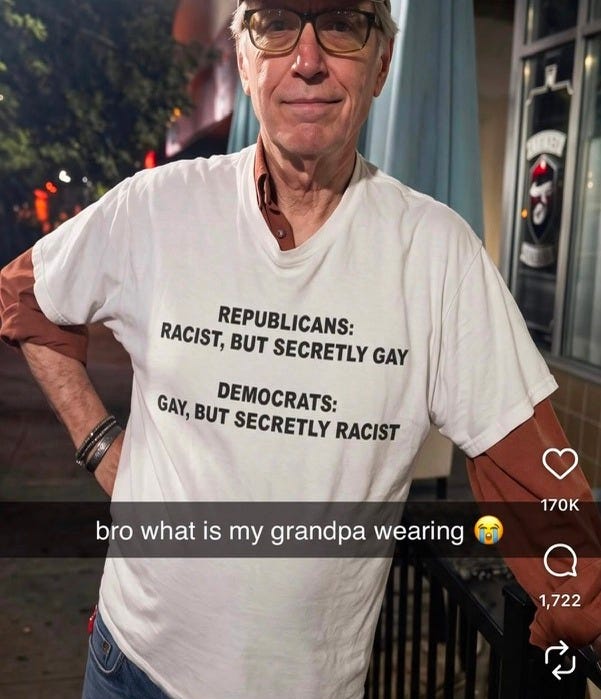
His shirt says Republicans, racist, but secretly gay. Democrats, gay, but secretly racist. And though I believe this meme is a little clever, a little funny, even one would say theoretically brilliant, I believe it deserves more unpacking. So I’m going to dissect this using three different academics, and then I’m going to do what the meme won’t do, which is go get the receipts, because a good joke and a good argument ain’t the same thing, and the folks in the back deserve to know the difference.
Let me say what the meme gets right before I say what it hides, because two things can be true. It is right that both parties run on a secret. It is right that the public performance and the private structure don’t match. It is right that the accusation each side throws at the other lands close enough to home that everybody laughs a little too hard. What it gets wrong is the arithmetic. The meme only counts to two. It knows racist and it knows gay and it treats them like two bags you can be caught holding, and the whole punchline depends on you never asking the obvious question, which is, what about the person who is Black and gay at the same time, in the same body, standing in the same voting booth. That person is not in the meme. That person is the reason the meme is funny and the reason the meme is a lie.
Crenshaw Says the Meme Only Counts to Two
Start with Kimberlé Crenshaw. Her framework of intersectionality says that race, class, gender, and sexuality are interlocking systems, not interchangeable ones, and when Crenshaw wrote that up in 1989 she wasn’t theorizing in the clouds, she was reading a case, DeGraffenreid v. General Motors, where five Black women sued GM and the court told them they could sue as Black people or they could sue as women but there was no such thing as a Black woman under the statute. The law only counted to two. Crenshaw’s whole intervention was to show what falls through the floor when you build a category system that can only hold one identity at a time.
Apply Crenshaw here. The meme is DeGraffenreid with a punchline. Republicans get one secret, Democrats get the other, and the two secrets are arranged so that they cancel each other out, racist over here, gay over there, and there is no cell in the grid for a Black lesbian in Houston or a Black gay man in Memphis or a Black trans woman anywhere. In “Mapping the Margins” in 1991 Crenshaw broke intersectionality into three kinds, structural, political, and representational, and the meme lives in that third one. Representational intersectionality is about how the images we make of people erase the folks who sit at the crossing. That is exactly what the shirt does. It makes a picture of American politics where race and sexuality are enemy flags, and it cannot see the people who are both flags at once, because seeing them would break the joke.
This is where some people might start to experience a little bit of discomfort, because the white gay progressives who love to ignore trans and BIPOC voices, but then hop into their neoliberal Democratic bags and start using racial rhetoric while pushing policies that devastate Black communities, are not going to like where this goes. You know damn well them data centers and how you cozy up to them tech companies is not finna get no good policies for us. In Memphis, a Democratic mayor and a Democratic majority sat still while xAI stacked dozens of gas turbines next to Boxtown and Whitehaven, historically Black neighborhoods that already carry the asthma, and the NAACP had to be the one to threaten suit. That’s what treating our identities like symbolic capital looks like in a zoning meeting. If you’re asking what I mean by that, I’m talking about tokens that you trade virtually, not no live simultaneous realities of actual people. Bourdieu called it symbolic capital, the prestige you can spend without it costing you anything, and Nancy Leong put a finer point on it in the Harvard Law Review in 2013 when she showed how institutions treat nonwhite identity as a commodity they can hold, display, and cash in on. Apply Leong to the Democratic half of the meme and you get the whole neoliberal playbook. The Black face on the flyer is the token. The tax abatement for the data center is the transaction. Same party, same week.

Historical Context: The Closet Has a Government Address
Now, before I get into who this funny looking white man is, let me lay the history down, because the meme is not new. It is the shorthand version of two real American stories that the meme has flattened into a shirt.
Story one is the Republican half. Racist, but secretly gay. That half has a name and a face and the face is Roy Cohn. Cohn was chief counsel to Senator Joseph McCarthy in 1953, and while the public remembers the Red Scare, the same machine ran what the historian David K. Johnson called the Lavender Scare. On April 27, 1953, President Eisenhower signed Executive Order 10450, which made “sexual perversion” grounds for termination from federal employment, and Johnson’s research estimates thousands of federal workers, somewhere in the range of five thousand and likely more once you count the military, were pushed out over the next two decades for being gay or being suspected of it. Cohn drove that machine. Cohn also died of complications from AIDS in August 1986 while publicly insisting he had liver cancer. That is reaction formation with a Senate office. Then, crazy how, Cohn’s most famous client after McCarthy was a young developer named Donald Trump, whom Cohn represented in 1973 when the Justice Department sued Trump Management for refusing to rent to Black tenants. The man who taught Trump how to fight was a closeted gay man who built his career hunting closeted gay men and then defended racial discrimination in federal court. The Republican half of the meme is not a theory. It is a biography.
Story two is the Democratic half. Gay, but secretly racist. That half has a date, and the date is November 4, 2008. California voted on Proposition 8, which banned same sex marriage, and the same night Barack Obama won the presidency the CNN exit poll reported that seventy percent of Black voters had voted yes on 8. Within days, white gay activists were on the internet and in the streets blaming Black people for the loss. Jasmyne Cannick, a Black lesbian organizer in Los Angeles, wrote in the LA Times that week about being called the n word at a No on 8 rally. Then in January 2009 the political scientists Patrick Egan and Kenneth Sherrill went back through the data for the Task Force and found the real number was closer to fifty eight percent, and that once you controlled for religiosity and age, Black voters looked like everybody else who went to church every week. The seventy was a bad sample from a handful of precincts. The blame was already out the door. A month after the election The Advocate put “Gay Is the New Black?” on its cover, which is a hell of a thing to print while your own movement is cussing out the actual Black people. That’s the Democratic half of the meme in one news cycle. Gay, loudly, on the marquee. Racist, quietly, in the comment section.
Then it kept going. In June 2015 an internal report on the Human Rights Campaign, the biggest LGBTQ lobbying organization in the country, leaked to the press, and its own staff described the place as a white gay men’s club where women, trans people, and people of color were sidelined. And this is the part where I want you to pay attention to how the law moved. The single biggest federal gay rights win of the Obama years, the Matthew Shepard and James Byrd Jr. Hate Crimes Prevention Act, was signed on October 28, 2009. It did not pass as a civil rights bill. It passed as a rider on the National Defense Authorization Act, the annual military spending bill. Chandan Reddy wrote a whole book about that, Freedom with Violence, and his argument is simple and brutal. In the United States the freedom of a marginalized group tends to arrive packaged inside the expansion of state violence, and hate crime enhancements expand the carceral system that already cages Black people at the highest rates in the country. Apply Reddy here. The meme says Democrats are gay but secretly racist. Reddy says look at the bill number. The gay part and the racist part rode in on the same piece of paper.
But the Democratic half runs deeper than 2008, because the party’s own civil rights history has a closet in it. Bayard Rustin organized the March on Washington. Rustin was also a gay man who had been arrested in Pasadena in 1953 on a morals charge, and in 1960 Congressman Adam Clayton Powell threatened to tell the press that Rustin and Martin Luther King Jr. were lovers if King didn’t call off a protest at the Democratic convention. King folded. Rustin resigned from the SCLC. Then in August 1963, weeks before the march, Strom Thurmond read Rustin’s arrest record into the Congressional Record from the Senate floor, and the movement had to decide whether to defend its own strategist. It did, barely. Kevin Mumford’s book Not Straight, Not White walks through how Black gay men like Rustin and James Baldwin were both indispensable to the movement and treated as liabilities by it, and how the 1965 Moynihan Report then pathologized the entire Black family as a matriarchal deviation, which put Black sexuality itself on trial. So when the meme says Democrats are gay but secretly racist, understand that the party’s coalition has been trading Black queer people for respectability since before most of the people wearing that shirt were born.
Why This Funny Looking White Man Looks So Spooked
Which takes me smoothly into this gentleman right here, German philosopher Theodor Adorno, who used Sigmund Freud’s psychoanalysis to build his own critical social theory and explain how modern capitalism and fascism control human psychology. I wonder why Adorno looks so spooked in all these pictures. Then again, the man watched his country vote for Hitler, fled to New York and then Los Angeles, and spent the 1940s trying to figure out on paper how ordinary people become fascists, so maybe the face is earned.
Specifically, I’m getting into his studies on projection and reaction formation. I know I love me a good theory, so I think y’all should add this to y’all lexicons. Projection is when what you cannot stand in yourself gets thrown onto somebody else, and reaction formation is when a repressed desire gets externalized as hostility toward the very thing you want. Freud named the mechanisms, his daughter Anna systematized them in 1936, and Adorno and Max Horkheimer picked them up in Dialectic of Enlightenment, where the chapter on antisemitism describes what they called false projection, the fascist habit of seeing in the Jew every appetite the fascist refuses to admit in himself. Then in 1950 Adorno and three colleagues published The Authoritarian Personality, a massive study funded by the American Jewish Committee that built the F scale, a questionnaire designed to measure how susceptible a person was to fascism, and one of the things the F scale looked for was exactly this, an exaggerated concern with other people’s sex lives, a punitive obsession with sexual deviance, paired with rigid loyalty to authority. Adorno’s finding was that the people most eager to punish the sexual “other” were the people most at war with their own desire.
It says Republicans, racist, but secretly gay, that’s reaction formation textbook. Homophobic performance as a defense against same sex desire. That’s what a lot of people are thinking, and that’s what you call that right there. Now let me be the researcher and not the meme for a second, because the science on this is more contested than the joke lets on. The study everybody cites is Adams, Wright, and Lohr in 1996 at the University of Georgia, which measured physiological arousal in a small group of men, thirty five who scored high on a homophobia scale and twenty nine who did not, and found the homophobic group showed more arousal to gay male erotica. It’s a famous result. It is also small, it has had mixed replications, and later work has pointed at other explanations, including anxiety, so I’m going to hold it the way a scholar holds it, as suggestive and not settled. What is settled is the pattern in the archive. Cohn. The Lavender Scare. The long list of anti gay legislators outed in airport bathrooms and congressional page programs. Adorno didn’t need a lab to see it. He watched it govern.
And Democrats, gay, but secretly racist, that’s liberal guilt and bad faith. Performative anti racism as a mask over subconscious bias. I read somebody in college by the name of Sartre and Arnold Farr who talked about bad faith and this idea of liberal guilt. Sartre’s version, in Being and Nothingness in 1943, is that bad faith is lying to yourself about your own freedom, playing a role so hard you forget you chose it. Farr, in his essay “Whiteness Visible,” takes that and puts race in it. He argues that white liberal consciousness is structured by a kind of learned not knowing, an epistemology of ignorance, where you can recite every antiracist slogan and still organize your material life around the very hierarchy you say you oppose, and the slogan does the work of protecting you from noticing. Apply Farr to the Democratic half of the meme. The performative anti racism is not a cover for the bias. The performative anti racism is the mechanism that keeps the bias from becoming visible to the person holding it. That is why it doesn’t feel like lying to them. Bad faith never does.
Here is the part where I have to be honest about my own source, because Research over MeSearch means I read the whole man and not just the good quotes. Adorno had his own closet problem. In Minima Moralia, the book he wrote in exile, there is a short aphorism called “Tough Baby” where he writes that totalitarianism and homosexuality belong together, and the logic he uses is almost exactly the meme’s logic, that the fascist tough guy is secretly the effeminate one. Scholars have rightly called that passage homophobic. So the meme’s Republican half is not just Adorno’s theory of reaction formation. It is Adorno’s own prejudice, laundered through a joke. Two things can be true. The man diagnosed the mechanism and the man was infected by it, and if you use his tools without noticing that, you end up doing the same thing the shirt does, which is making gayness the insult you hurl at your enemy. Liberalism is a hell of a drug, and so is theory.
That’s the dialectical trap I mentioned. The meme lowkey illustrates a closed loop of accusation that neutralizes the critique by mirroring it. Each side says the other side’s public politics are a lie. Each side is right. And because each side is right, nobody has to do anything, because the accusation has already been answered by the counter accusation. It feels like exposure. It functions like a truce.

The Closet Was Never Raceless
My last point comes from Eve Kosofsky Sedgwick, who is considered one of the founders of queer theory. You see her haircut and them glasses. Even like she had that drip in her closet though. But she says the closet isn’t just about sexuality. In Epistemology of the Closet in 1990 Sedgwick argued that the closet is a structure of the known versus the unknown, the private against the public, the open secret that everybody knows and nobody says, and she argued that the closet has been the defining structure of gay oppression in the twentieth century. She also gave us a phrase I want y’all to keep, the privilege of unknowing. Ignorance is not the absence of power. Ignorance is a position, and the powerful get to occupy it at will. Then, five years before Epistemology, in Between Men, she showed how homophobia works as a regulator of male bonding, how men keep each other in line by threatening each other with the accusation of desire, which she called homosexual panic, and which is still, in most states, a legal defense you can raise after killing a gay man.
This meme weaponizes all of that. Your public politics are always a lie. The shirt uses the structure of the closet as a universal solvent. It says both parties have a secret self, and the secret self is the true one, and therefore public commitments are theater. That’s a paranoid reading, and Sedgwick, in her later work, actually named that habit and asked whether we could do better. Hold that thought, I’m coming back to it.
Because first I need to correct Sedgwick, and Marlon B. Ross already did it for me. In his essay “Beyond the Closet as Raceless Paradigm” in the 2005 Black Queer Studies collection, Ross argues that the closet, as queer theory built it, assumes a white subject. The whole drama of the closet is a drama of a person who is presumed normal, presumed to belong, whose secret is the only thing that could expel them from belonging. Black people were never presumed to belong. Ross points out that the “coming out” narrative, moving from a private hidden self to a public visible self, depends on a public that will treat you as an individual once you show yourself, and that public has never existed for Black people, who were already hypervisible, already read as sexually excessive, already surveilled, already outside the norm before they ever said a word about who they loved. For a Black gay man, Ross argues, the closet is not the primary structure. Race is. Sexuality gets folded into a body that was already marked.
Apply Ross to the meme and the whole thing tilts. The shirt assumes two closets, a Republican one hiding gayness and a Democratic one hiding racism, and both closets are white rooms. Neither closet has a Black person in it because Ross is right, the closet was never our architecture. Our architecture was the plantation, the pathology report, the police file. The meme is a joke about white secrets told in a white grammar, and it only reads as universal because whiteness always reads as universal. By running the meme through Ross, you make its whiteness visible, and that, kinfolks, is the actual critique.
The Committee That Came for the NAACP Learned to Come for the Teachers
Here is where the meme’s two secrets stop being a joke and start being a syllabus, because in the history of American schooling the attack on Black people and the attack on gay people have used the same committee, the same statutes, and the same fear.
In 1956, two years after Brown v. Board of Education, the Florida legislature created the Florida Legislative Investigation Committee, remembered by its chairman’s name as the Johns Committee. Charley Johns was a former acting governor and a segregationist, and the committee’s founding mission was to destroy the NAACP in Florida by tying it to communism and forcing its membership lists into the open so members could be fired, evicted, and terrorized. The NAACP fought it all the way up, and in Gibson v. Florida Legislative Investigation Committee in 1963 the Supreme Court held that the state could not force the Miami branch president, Theodore Gibson, to hand over the membership rolls. The committee lost. So it pivoted. Starting in 1958 the Johns Committee turned the same investigators, the same subpoena power, and the same informants against gay and lesbian teachers and professors, first at the University of Florida, where more than a dozen faculty and staff were forced out in 1959, and then across the public schools, where teachers were interrogated in motel rooms and had their certificates revoked. Karen Graves documented this in And They Were Wonderful Teachers, and Stacy Braukman put it in its Cold War frame in Communists and Perverts Under the Palms. In 1964 the committee published a report titled Homosexuality and Citizenship in Florida, with a purple cover, which was so lurid that the backlash finally killed the committee in 1965. But not before it had done its work.
Apply Graves here. The Johns Committee is the education version of the meme with the joke removed. The racist project and the anti gay project were not two secrets held by two parties. They were one budget line, one chairman, one set of filing cabinets. When the state could not purge Black organizers it purged gay teachers, and it justified both with the same word, security. Then think about who was in those classrooms. The Black teachers who survived the post Brown purge, which displaced tens of thousands of Black educators across the South, and the gay teachers who survived the Johns Committee, were often the same people, and the ones who were both had to dissemble twice.
Now bring it forward. Florida’s HB 1557 in 2022, the law the country called Don’t Say Gay, and Florida’s HB 7 the same year, the Stop WOKE Act, were written by the same legislature in the same session with the same structure, a prohibition on classroom “instruction” about a category of person, enforced by parent complaints and the threat of a teacher’s license. PEN America counts both under one heading, educational gag orders, because that is what they are. Texas did it too, banning the teaching of the 1619 Project and “critical race theory” in 2021 while pushing the same era’s restrictions on trans students. The template did not change from 1956. Race and sexuality are still investigated by the same committee. The only thing the meme gets wrong is the idea that the two attacks come from opposite parties. In the schoolhouse they have always come from the same door.
And the discomfort I promised earlier applies here too. Democratic school boards and Democratic mayors run cities where Black children are suspended at three times the rate of white children and where a Black queer kid can be pushed out of a school for their hair, their clothes, or their attitude under a discipline code written in race neutral language. The party that says gay at the podium and racist in the discipline data is a real party. I have been in those rooms. Sedgwick’s privilege of unknowing has a school district.
Dissemblance Ain’t a Closet, It’s a Survival Strategy
Intersectionality is not a slide I add at the end. It is the frame. So let me center the people the meme literally cannot draw, Black women and Black queer folks, and let me center their material outcomes rather than their symbolic representation.
Start with the numbers, because the shirt has none. Black people are roughly twelve percent of the U.S. population and account for close to four in ten new HIV diagnoses, according to the CDC’s most recent surveillance, with Black gay and bisexual men carrying the heaviest burden of any group in the country. The Human Rights Campaign’s tracking of fatal violence against transgender people has, year after year, found that most of the people killed are Black transgender women. The Williams Institute at UCLA found in 2019 that Black LGBT adults live in poverty at roughly double the rate of white LGBT adults, around three in ten. None of those people are Republicans hiding a boyfriend or Democrats hiding a bias. They are the people standing where the meme’s two secrets cross, and the crossing is a graveyard.
Evelynn Hammonds gives the theory for why the meme can’t see them. In “Black (W)holes and the Geometry of Black Female Sexuality” in 1994, Hammonds argued that Black women’s sexuality has been treated in American discourse as a void, a black hole, something known only by the way it warps everything around it and never on its own terms. White women’s sexuality gets to be the visible norm, and Black women’s sexuality is either pathologized as excess, the Jezebel, or erased altogether, the mammy, and Black lesbian sexuality is erased twice, once by racism and once by a queer movement built on white women’s visibility. Hammonds builds on Darlene Clark Hine, who in 1989 named the culture of dissemblance, the way Black women after slavery cultivated a public appearance of openness while sealing off their inner lives, precisely because the sexual violence of the plantation and the Jim Crow household made honesty dangerous. Apply Hine here. Dissemblance is not a closet. A closet is where you hide a desire. Dissemblance is where you hide your entire interior from a world that has already decided what your body is for. Sedgwick’s closet is a door in a house. Hine’s dissemblance is a wall you build because you were never given a house.
That is why the meme’s grammar fails Black women completely. It offers two secrets, gay and racist, as if the only things a person could be hiding are a desire or a prejudice. Black women have been hiding survival. And the Democratic coalition that spends Black women’s votes every November, the ninety plus percent that show up in every exit poll, and then hands the policy portfolio to the tech companies and the police unions, is doing to Black women exactly what Hammonds describes, using them as the gravitational center of the party while refusing to see them as subjects. Symbolic capital. Tokens traded virtually. Not live simultaneous realities.
And the Republican coalition that says Black women don’t exist as a category, that files the executive orders killing the race by sex data the government has collected since 1966, is doing the same thing from the other side of the shirt. Erasure from the left as tokenization, erasure from the right as elimination. The two halves of the meme meet in a Black woman’s body and neither one of them notices she is there.
Reparative Reading, or Cheryl Clarke Already Told Us
I told you I would come back to Sedgwick, and here is why it matters. In 1997 she published an essay called “Paranoid Reading and Reparative Reading,” where she looked at her own field and asked why every critical move had become an exposure, a gotcha, a demonstration that the thing you thought was innocent is secretly guilty. She called that paranoid reading. It is strong, it is anticipatory, it protects you from surprise, and it is exhausting, and it never builds anything. Her alternative was reparative reading, an approach that asks not what is secretly wrong with this thing but what can be assembled from it, what nourishment can be pulled out of a damaged world. The meme is paranoid reading on a shirt. Both parties are secretly the worst. Now what. Nothing. That is the answer paranoia gives. Nothing.
So let me do the reparative move, and let me do it with somebody who did it first. In 1983 Cheryl Clarke, a Black lesbian poet and organizer, published “The Failure to Transform: Homophobia in the Black Community” in Home Girls, the anthology Barbara Smith edited out of the same circle that produced the Combahee River Collective statement in 1977. Clarke did not write a meme. She wrote a critique from inside, naming the homophobia of Black nationalist men and Black churches without ever once handing white people a weapon, and she paired it with a demand, which was that Black liberation has to include Black lesbians and gay men or it is not liberation. That is the Southern Black Left way of doing this. You critique your own house and you stay in it and you build. Combahee had already said that the major systems of oppression are interlocking, and they said it eleven years before Crenshaw gave the idea a legal name, and they said it as Black lesbians who had been asked to choose between the Black movement and the women’s movement and the gay movement and had answered, no, we are all three, and the fact that you can’t see that is your failure, not ours.
Apply Clarke here. The meme wants you to laugh at two parties. Clarke wants you to look at your own coalition and ask who it is asking to wait. That is a harder ask and it is the only one that goes anywhere. See, Ross reminds us the closet was never built for us, and Hammonds teaches us that our silences have a different geometry, and Clarke shows us that the answer to a paranoid joke is not a better joke, it is a movement with room in it.
Conclusion
In conclusion, I hope this video illustrated in many ways that you can always still critique things that you find humorous or clever. The shirt is funny. The shirt is also a closed loop, a white grammar, a paranoid reading, and a picture of American politics with no Black gay person in it. Crenshaw shows the erasure. Adorno shows the mechanism and then shows you his own infection. Sedgwick gives you the closet and Ross tells you the closet never had a Black door. And the Johns Committee, and Roy Cohn, and Proposition 8, and the hate crimes bill on the military budget, and Bayard Rustin resigning from the SCLC, are the receipts that the meme skipped on its way to the punchline.
And I hope this encourages you to follow me on Substack where I’m currently ranked number 85 in education. I’ve got to get higher than that though, man. But if you’re looking for a deeper dive in essay with cited sources on this topic specifically, go on and follow me over there. Education Is Elevation is actually what it’s called.
5 KEY TAKEAWAYS
The meme only counts to two. Crenshaw’s DeGraffenreid problem is the meme’s problem: a category grid that holds “racist” and “gay” as opposite flags has no cell for the Black gay person standing in both.
The Republican half has a biography, not a theory. Roy Cohn ran the Lavender Scare, died of AIDS denying it, and in 1973 defended Donald Trump against a federal housing discrimination suit.
The Democratic half has a bill number. The Shepard Byrd Hate Crimes Act became law in 2009 as a rider on the military budget, and the Prop 8 “seventy percent” blame on Black voters was a bad exit poll the movement never retracted.
The closet was never raceless. Marlon Ross corrects Sedgwick: Black people were hypervisible and surveilled before they said a word about desire, so the “coming out” drama assumes a belonging Black people never had. Hine and Hammonds show Black women live behind dissemblance, not a closet.
Race and sexuality get investigated by the same committee. Florida’s Johns Committee was built in 1956 to destroy the NAACP, lost at the Supreme Court, and pivoted to purging gay teachers. Don’t Say Gay and Stop WOKE came out of the same session in 2022. Same door, always.

PAID SUBSCRIBER ASK
The meme can only count to two because it was made by people who never had to hide survival, and the archive that proves it, from the Johns Committee’s filing cabinets to Egan and Sherrill’s corrected Prop 8 data, only stays open if somebody keeps the lights on. Black male educators are less than two percent of this profession, and I am that two percent, fighting alone against the systematic erasure of our histories, our legal protections, and our cultural truth. I’m independent with no corporate sponsor and no safety net; this work lives or dies on the support of this community. If every one of you reading this converted to a paid subscriber today, we would stop surviving and start building: a permanent, independent archive of Black expertise with the depth of PBS and the fire of our ancestors. So here is the ask: become a paid subscriber.
RELATED READINGS (Bibliography)
Adams, Henry E., Lester W. Wright Jr., and Bethany A. Lohr. “Is Homophobia Associated with Homosexual Arousal?” Journal of Abnormal Psychology 105, no. 3 (1996).
Adorno, Theodor W. Minima Moralia: Reflections from Damaged Life. 1951. Aphorism 24, “Tough Baby.”
Adorno, Theodor W., Else Frenkel Brunswik, Daniel J. Levinson, and R. Nevitt Sanford. The Authoritarian Personality. Harper, 1950.
Adorno, Theodor W. “Freudian Theory and the Pattern of Fascist Propaganda.” 1951.
Bourdieu, Pierre. “The Forms of Capital.” In Handbook of Theory and Research for the Sociology of Education, 1986.
Braukman, Stacy. Communists and Perverts Under the Palms: The Johns Committee in Florida, 1956 to 1965. University Press of Florida, 2012.
Clarke, Cheryl. “The Failure to Transform: Homophobia in the Black Community.” In Home Girls: A Black Feminist Anthology, edited by Barbara Smith. Kitchen Table Press, 1983.
Combahee River Collective. “A Black Feminist Statement.” 1977.
Crenshaw, Kimberlé. “Demarginalizing the Intersection of Race and Sex.” University of Chicago Legal Forum, 1989.
Crenshaw, Kimberlé. “Mapping the Margins: Intersectionality, Identity Politics, and Violence against Women of Color.” Stanford Law Review 43 (1991).
DeGraffenreid v. General Motors Assembly Division, 413 F. Supp. 142 (E.D. Mo. 1976).
Egan, Patrick J., and Kenneth Sherrill. “California’s Proposition 8: What Happened, and What Does the Future Hold?” National Gay and Lesbian Task Force Policy Institute, January 2009.
Farr, Arnold. “Whiteness Visible: Enlightenment Racism and the Structure of a Racialized Consciousness.” In What White Looks Like, edited by George Yancy. Routledge, 2004.
Freud, Anna. The Ego and the Mechanisms of Defence. 1936.
Gibson v. Florida Legislative Investigation Committee, 372 U.S. 539 (1963).
Graves, Karen L. And They Were Wonderful Teachers: Florida’s Purge of Gay and Lesbian Teachers. University of Illinois Press, 2009.
Hammonds, Evelynn. “Black (W)holes and the Geometry of Black Female Sexuality.” differences 6, nos. 2 and 3 (1994).
Hine, Darlene Clark. “Rape and the Inner Lives of Black Women in the Middle West: Preliminary Thoughts on the Culture of Dissemblance.” Signs 14, no. 4 (1989).
Horkheimer, Max, and Theodor W. Adorno. Dialectic of Enlightenment. 1944/1947. “Elements of Anti Semitism.”
Johnson, David K. The Lavender Scare: The Cold War Persecution of Gays and Lesbians in the Federal Government. University of Chicago Press, 2004.
Leong, Nancy. “Racial Capitalism.” Harvard Law Review 126, no. 8 (2013).
Mumford, Kevin. Not Straight, Not White: Black Gay Men from the March on Washington to the AIDS Crisis. University of North Carolina Press, 2016.
Reddy, Chandan. Freedom with Violence: Race, Sexuality, and the US State. Duke University Press, 2011.
Ross, Marlon B. “Beyond the Closet as Raceless Paradigm.” In Black Queer Studies: A Critical Anthology, edited by E. Patrick Johnson and Mae G. Henderson. Duke University Press, 2005.
Sartre, Jean Paul. Being and Nothingness. 1943. Part One, Chapter Two, “Bad Faith.”
Sedgwick, Eve Kosofsky. Between Men: English Literature and Male Homosocial Desire. Columbia University Press, 1985.
Sedgwick, Eve Kosofsky. Epistemology of the Closet. University of California Press, 1990.
Sedgwick, Eve Kosofsky. “Paranoid Reading and Reparative Reading, or, You’re So Paranoid, You Probably Think This Essay Is About You.” In Touching Feeling. Duke University Press, 2003.


