

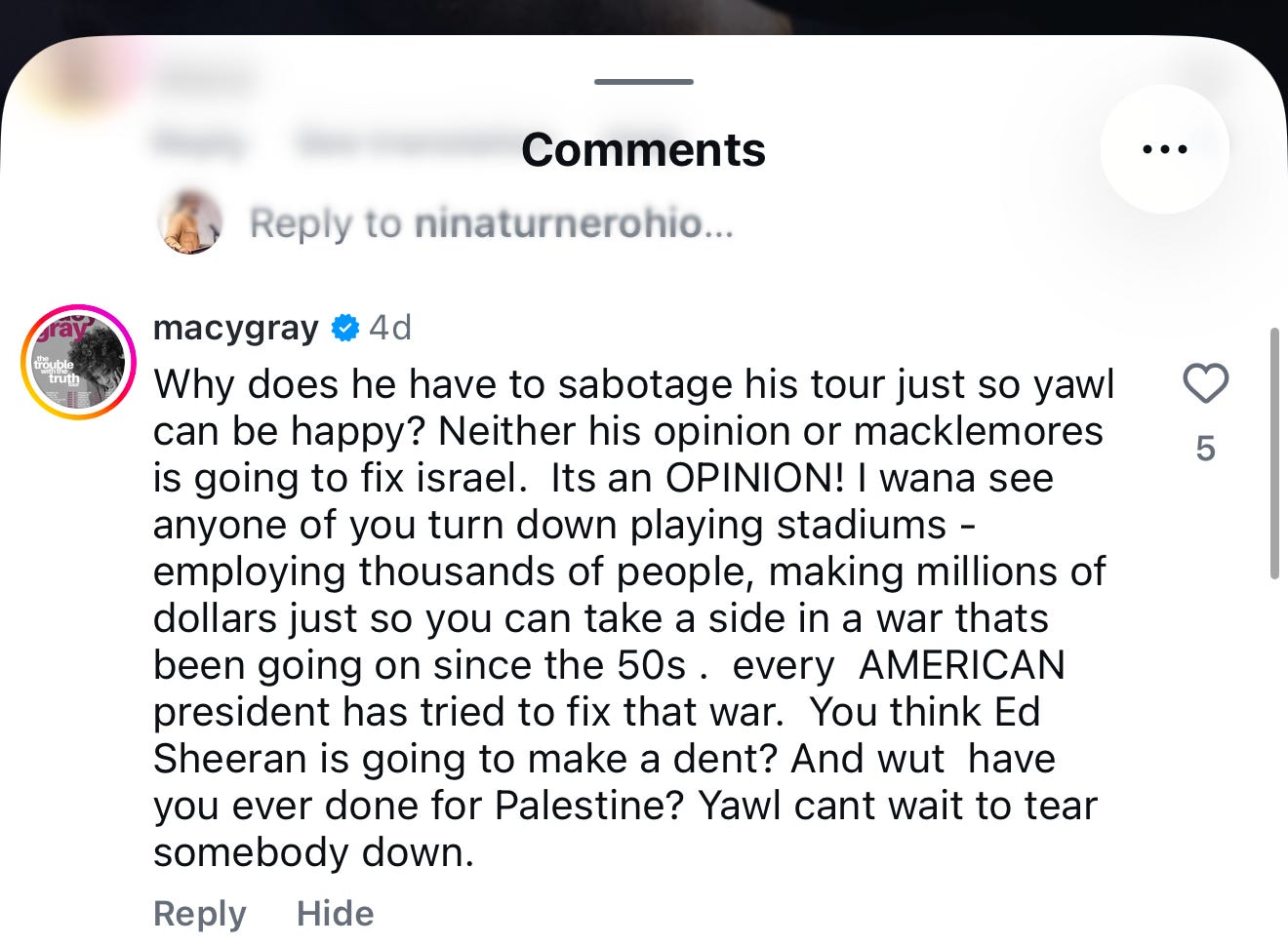
Macy Gray, respectfully, you are wrong as two left shoes for the comments you left under my post concerning the Ed Sheeran tour. Now as a Southern man that was taught to have respect for my elders, even when you think they are wrong, I hope you do not take this as condescending or patronizing, because I’m about to use my transferable skills of being a professor of adult and higher education, as well as having a master’s in human relations, to illustrate to you point for point why you were wrong. Not to slam dunk on you. To do what I was trained to do, which is take a comment, break it into its claims, and check every one of them against the record.
Because here is the thing about what you wrote, Ms. Gray. You did not leave an opinion. You left a series of claims that can be tested, and then you put the word OPINION in all caps on top of them like a tarp over a leaking roof. Then you hoped nobody would look under the tarp. Ahh, but somebody looked..
Let me read it back to you the way you wrote it. You started off by saying, why does he have to sabotage his story just so y’all can understand? You went on to say, neither his opinion or Macklemore’s is going to fix Israel. You said, I want to see any one of you turn down playing in stadiums, employing thousands of people, making millions of dollars, just to take a side in a war that’s been going on since the 50s. Then you said, you think Ed Sheeran is going to make a dent? What have you ever done for Palestine? Y’all can’t wait to tear somebody down.
Four moves. Every one of them is going to get graded.
Move One: “Why does he have to sabotage his story?”
Ms. Gray, Ed Sheeran did not sabotage anything. A billionaire sabotaged Ed Sheeran, and Ed Sheeran let him. Let’s put the timeline on the table so we are working from the same facts.
Macklemore opened for Sheeran at MetLife Stadium in New Jersey on September 4 and 5, 2026. He wore a keffiyeh, he said the words Free Palestine, he performed Hind’s Hall while footage from Gaza played on the screens, and he told the Jewish folks in the building, in his own words, that criticism of a state is not criticism of a people. That is what happened on that stage. Then Pink reposted a StopAntisemitism story demanding he be removed from the tour, and a week later she wrote a three part statement saying she never asked for anybody to be silenced. Two things can be true. She amplified the call to remove him, and then she said she never asked for it. We call that shucking and jobbing.
Then Robert Kraft, owner of the New England Patriots and Gillette Stadium, got on the phone with Sheeran. By Macklemore’s own account, and Sheeran’s cousin and the reporting since have not contradicted it, Kraft told Sheeran that if Macklemore was on the bill, the Foxborough shows on September 25 and 26 were off, and that he had rallied other stadium owners to hold the same line. Kraft’s own statement said the quiet part in public: Gillette Stadium, he said, would not provide a platform for what he called hate speech, and he cited Macklemore’s stage material as the reason. On September 14 the promoter, Messina Touring Group, announced that venues had refused to host the tour with Macklemore on the lineup and that Macklemore would not be performing on the remaining U.S. dates. Sheeran said the decision was the promoter’s. The promoter said it was the venues’. The venues are owned by billionaires. Follow the money and you find the mouth.
Then here is the part you skipped, Ms. Gray. Every single remaining opening act quit. Finneas, Aaron Rowe, Beoga, Lukas Graham. All of them. Sheeran walked out in Philadelphia on September 19 with no openers, cried on stage, said he had made mistakes, and told the crowd he never wanted to be an activist musician. Ticket resale prices dropped to 42 dollars. That is not Macklemore sabotaging Ed Sheeran’s story. That is what happens when you let a stadium owner write your set list. The sabotage came from the top of the building, not from the opening act.
So when you ask why should Ed Sheeran have to sabotage a successful tour, the honest question is why should a billionaire get to sabotage a successful tour where an artist was already exercising freedom of speech with his artistry, and why did you decide the artist was the problem?
Move Two: “It’s just an opinion”
This is the move that made me want to teach.
See, the thing about opinions, Ms. Gray, is they are non falsifiable, meaning they cannot be proven true or false. An opinion is, I believe jazz is better than R&B. You feel me? That is subjective. Nobody can run a test on it. What you wrote is not that. What you wrote is a set of empirical claims, and empirical claims can be checked. So let me check them.
You said it is a war that has been going on since the 50s. The number is 1948. In Arabic it is called the Nakba, the catastrophe, and it is not an opinion. Between late 1947 and 1949 roughly 750,000 Palestinians were expelled or fled from their homes, more than 400 villages were depopulated and destroyed, and on April 9, 1948, at Deir Yassin, over 100 villagers were killed by Irgun and Lehi fighters in a massacre that sent panic through the countryside and accelerated the flight. Their descendants are still refugees to this day, registered with UNRWA in Gaza, the West Bank, Lebanon, Syria, and Jordan. When you say the 1950s, you are not stating a position. You are stating a date, and the date is wrong. So everything you built on top of that date is built on sand.
You said, neither his opinion or Macklemore’s opinion is going to fix Israel. Ms. Gray, Israel is not the one that needs fixing. Gaza is rubble. Here is what the courts, not the activists, the courts, have said. In January 2024 the International Court of Justice found it plausible that Israel’s conduct in Gaza violated the Genocide Convention and ordered provisional measures. In July 2024 the same court issued an advisory opinion that Israel’s occupation of Palestinian territory is unlawful and must end. In November 2024 the International Criminal Court issued arrest warrants for Netanyahu and Gallant for war crimes and crimes against humanity, including starvation as a method of warfare. In September 2025 the UN Commission of Inquiry concluded that Israel has committed genocide in Gaza. Those are not opinions. Those are findings by bodies with jurisdiction, rules of evidence, and judges. You can disagree with them, but you cannot call them an opinion and walk away.
You said every president has tried to end it. Every president has armed one side of it. Since the 1970s the United States has been the principal supplier of weapons to Israel, and under the 2016 memorandum of understanding the floor is 3.8 billion dollars a year through 2028, before the supplemental packages since October 2023 that pushed it into the tens of billions. That is your tax dollars, Ms. Gray. Mine too. When you say every president has tried to end it, the arms ledger says every president has funded it. Apply Mills here. Mills calls this white ignorance, and he is careful to say it is not stupidity, it is a structure, a way of not knowing that gets protected because knowing would cost something. The word “opinion” in your comment is the tarp. It is the mechanism that lets a person with access to every fact I just listed say “who’s to say” and keep their brunch reservation.
So no, Ms. Gray. What you wrote was not an opinion. It was misinformation.
Move Three: “I want to see any of you turn down a stadium”
Ms. Gray, we all got options and choices. When you say you want to see anybody turn down a stadium, playing in front of tens of thousands of people, employing thousands of people, making millions of dollars, you are trying to provoke an emotional response, and you are pretending the thing you are describing has never happened. It has happened. It has happened so many times that there is a whole shelf of history about it, and most of it was written by Black artists.
Historical context, the part they skip in the group chat
Start with Paul Robeson. In 1950 the State Department revoked his passport because he would not stop speaking about colonialism, lynching, and the Soviet Union in the same breath. His income went from over 100,000 dollars a year to a few thousand. Concert halls cancelled. Record labels dropped him. He did not get his passport back until 1958. That is a man who did not turn down a stadium. The stadium got taken from him, and he kept singing anyway.
Then Harry Belafonte. He funded SNCC out of his own pocket, bailed out Freedom Riders, and in 1968 guest hosted The Tonight Show for a week and put Dr. King and Bobby Kennedy on the couch. Belafonte did not have to do any of that. He had the stadiums. He used them.
Then 1985. Steven Van Zandt organized Artists United Against Apartheid, 49 artists including Miles Davis, Gil Scott Heron, Run DMC, Bonnie Raitt, and Bruce Springsteen, and they recorded Sun City, a song whose entire message was I ain’t gonna play there. Sun City was a resort in the Bophuthatswana bantustan where the apartheid government paid Western entertainers millions to play so the world would believe things were normal. The United Nations kept a register of entertainers who took the money. Some of the biggest names in music were on that list. The artists who refused lost checks. The artists who played got their names published as collaborators. That is the exact choice you just said nobody makes, Ms. Gray. Whole careers were built on making it.
Then the part that matters most for this conversation, because it is the Black and Palestine part. Fischbach documents that in the summer of 1967, right after the Six Day War, SNCC published a newsletter with a two page piece on Palestine, and the price was immediate. Jewish donors who had funded the movement pulled out. Liberal allies broke. The organization was already under pressure, and Palestine became the reason a lot of people had been looking for. Two years later the Black Panther Party opened its own relationship with the PLO and paid for it in the press. Then 1979, Andrew Young, Dr. King’s lieutenant, the first Black U.S. ambassador to the UN, resigned after it came out that he had met with the PLO’s UN observer. One meeting. Career over at that post. Fischbach’s point across two books is that Palestine has functioned since 1967 as a test that Black organizers and artists could not pass without paying, and that the payment was never symbolic. It was donors, jobs, stages, and passports.
So when you say you want to see somebody turn down a stadium, the answer is you are looking at them. Macklemore just did. He is donating the entire one million dollars of his net earnings from the tour to six Palestinian relief organizations and invited Kraft to match it. Four more openers walked away from stadium money the same week. The history is not hypothetical. You just did not want to be in it.
Move Four: “What have you ever done for Palestine?”
Ms. Gray, here is a photo of my name spray painted in the rubble in Gaza, because my advocacy for Palestinians made its way from Texas all the way to the West Bank and into Gaza. Do you know how sad and empowering it was at the same time to see that? That is how much destruction there is. Enough rubble to write on. Enough rubble that folks over there know the names of the people over here who refuse to be quiet.
Then look at the logic. You said y’all can’t wait to tear somebody down. Why isn’t that directed at Robert Kraft, who used his stadium to pull an artist off a tour for saying children should not be bombed in tents? Why isn’t that directed at Pink, who reposted a call to remove him and then said she never asked for that? How come you ain’t got that beef with them? That is the two roles frame, and it is the whole game. What you said was defend Ed Sheeran. What your comment structurally did was defend the billionaire’s right to decide what an artist can say on a stage he owns. Those are two different jobs, and you signed up for the second one without reading the contract.
Because here is the question I need you to sit with, Ms. Gray. What if a billionaire said this tour will not be performed in my stadium if y’all let Macy Gray hit the stage? What would that mean for you? What would it mean for every billionaire to start feeling like, because they have the means, they can dictate what artists say on stage, and if it hurts their feelings or pisses on what they believe, then you can’t say it? You are a Black woman who has said things on stage and in interviews that made powerful people uncomfortable. You have been on the other side of that kind of phone call. You know what it is to have a career get quiet after you spoke.
That is why the word “opinion” is doing so much heavy lifting in your comment. If it is all just opinions, then Kraft’s opinion and Macklemore’s opinion are equal, and the guy with the stadium wins the tie. Once you accept that framing, you have already lost the argument for every artist who comes after you, including yourself.
THE SYLLABUS SAYS “OPINION,” THE STATE SAYS “SIGN HERE”
The specific implication for education
I teach adults. My whole discipline is built on one distinction, and it is the one Macy Gray’s comment collapsed: the difference between a claim you can test and a claim you can only feel. Wineburg calls the skill historical thinking, and his research at Stanford found that most students, and most adults, cannot tell the difference between a source that documents something and a source that just asserts it with confidence. He calls the fix civic online reasoning, and the first move is always the same. Ask what kind of statement this is. Is it falsifiable? If it is, go check. If it is not, label it and move on. Apply Wineburg here. “The war started in the 50s” is falsifiable. “Every president tried to end it” is falsifiable. “It’s just an opinion” is the thing a person says when they do not want to be checked.
Now here is why this is not just a media literacy lecture. In Texas, where I live, the state has already decided that Palestine is a subject you can be fired for. In 2017 Texas passed HB 89, which required anybody contracting with a state entity to certify they do not boycott Israel. In 2018 Bahia Amawi, a speech pathologist who had worked with children in Pflugerville ISD for nine years, was handed her renewal contract with a no boycott of Israel clause in it. She refused to sign. She lost her job. In April 2019 a federal judge in Austin, Robert Pitman, blocked the law, writing that it plainly targeted political speech, and the legislature responded by rewriting the statute to exempt sole proprietors and small contracts so the case would be mooted, and the Fifth Circuit obliged. The principle survived. A Texas teacher’s ability to hold a position on Palestine is still subject to a clause in a contract.
Then go one level up. Giroux’s whole argument is that the classroom is where a society rehearses what it will allow to be said, and that the “neutral” classroom is a classroom that has already decided in favor of the people who own the building. Apply Giroux here. When a state tells a speech pathologist to sign a loyalty clause, and when a billionaire tells a promoter to pull an opening act, they are running the same play at different scales. The stadium and the schoolhouse are teaching the same lesson: your speech is welcome up to the point where it costs the owner something.
So the education implication of Macy Gray’s comment is not about Macy Gray. It is that an entire generation is being taught, by contract and by example, that “it’s just an opinion” is the safe thing to say about a documented catastrophe, and that the artists who say more than that get removed from the bill. Which means the students I teach have to be taught, on purpose, how to tell a falsifiable claim from a feeling, because the state and the stadium are teaching them not to.
THE STAGE ALWAYS COLLECTS FROM BLACK WOMEN FIRST
Intersectional material impacts
Here is what makes the Macy Gray comment hurt instead of just being wrong. A Black woman artist is defending the machinery that has historically collected its debts from Black women artists first.
Feldstein’s book is a ledger of exactly this. Hazel Scott was the first Black woman to host her own national television show, in 1950. She was named in Red Channels, testified before the House Un American Activities Committee in September of that year, refused to name names, and DuMont cancelled her show within a week. Her U.S. career never recovered and she moved to Paris. Nina Simone wrote Mississippi Goddam in 1964 after Medgar Evers was murdered and four girls were killed in Birmingham. Radio stations in the South returned promotional copies of the record broken in half. She later said the industry punished her for it and she was right; the bookings thinned, and she spent much of the rest of her career outside the country. Eartha Kitt went to a White House luncheon in January 1968, told Lady Bird Johnson to her face that mothers were sending their sons to be shot in Vietnam, and the CIA compiled a file on her. She could not get booked in the United States for the better part of a decade. Feldstein’s point is that Black women entertainers were the civil rights movement’s most visible spokespeople and the movement’s most disposable ones. The stages they were given could be taken back in one afternoon.
Then Brooks adds the part that connects it to the word “opinion.” Brooks argues that Black women musicians have always been intellectuals, that Simone’s rage and Scott’s refusal and Kitt’s directness were arguments, not moods, and that the industry’s favorite way to neutralize them was to reclassify their arguments as feelings. Apply Brooks here. That is what “it’s just an opinion” does. It is the same move the industry has run on Black women for a century: your analysis is a feeling, and feelings do not get to cost the owner money.
So look at the material outcome. The artists who will feel this precedent hardest are not Ed Sheeran, who cried in Philadelphia in front of 50,000 people and kept the tour. It is the Black woman opening act on somebody else’s bill two years from now, who now knows that a stadium owner can pull her for a keffiyeh, a chant, or a line about a drone strike, and that a fellow Black woman artist with a platform will log on and say what did you expect. The precedent Macy Gray defended will not be enforced against Macy Gray first. It will be enforced against whoever has the least leverage, and in this industry that has always been a Black woman with a political point and no billionaire behind her.
Then the Palestinian side of the same ledger, because intersectionality is not a metaphor. Hind Rajab, the child that Macklemore’s song is named for, was five years old when she was killed in a car in Gaza City in January 2024 alongside her family, and the paramedics sent to reach her were killed too. The people who bear the largest share of a siege are women and children, and the people who bear the largest share of a blacklist are women artists. The billionaire veto sits at the exact intersection where both bills come due.
THEY TOOK ROBESON’S PASSPORT. HE SANG ACROSS THE BORDER.
Counterweight: the tradition is bigger than the stadium
I do not want to end this on the losses, because the tradition Macy Gray is standing outside of did not lose.
Redmond’s work on Robeson and on anthems in the diaspora makes a point that matters here. When Robeson could not leave the country, in 1952 he stood on a flatbed truck at the Peace Arch on the Washington and British Columbia border and sang to 40,000 people gathered on the Canadian side, because the border could not stop sound. He did it again every year until the passport came back. Redmond’s argument is that Black political music has never needed the venue’s permission, that the anthem, the chant, the song passed hand to hand, is a form of organization that travels where the singer cannot. Apply Redmond here. Kraft took the Foxborough stage. He did not take Hind’s Hall. That song has been played more this month than in the two years since it came out, and a million dollars just moved to Gaza because of a set that got cancelled.
The Sun City artists lost checks and won the argument. SNCC lost donors and was right about 1967 in 1967. Belafonte gave stadiums away and died with more respect than any billionaire who ever owned one. Macklemore lost eight shows, gave away the money from the rest, and the four artists behind him walked out on stadium money to stand with him. That is the tradition. That is the choice Macy Gray said nobody makes. People make it every week, and the ones who make it are the ones we still talk about.
See, Fischbach reminds us that the price for saying Palestine has been collected from Black organizers and artists since 1967, and that the ones who paid it are the reason there is still a movement to join. Feldstein teaches us that Black women artists have always been the first to be billed for their politics and the last to be credited for their analysis. Then Redmond shows us that a stage is a thing an owner controls, and a song is a thing an owner never has.
5 KEY TAKEAWAYS
“It’s just an opinion” is a claim about the kind of statement you are making, and Macy Gray’s statements were falsifiable. 1948 is not the 1950s. The ICJ, ICC, and UN findings are not opinions. The arms ledger is not an opinion.
Ed Sheeran did not sabotage his tour. A stadium owner did, and Sheeran let him. Every remaining opener quit rather than perform under that precedent.
Artists have turned down stadium money for politics for seventy years: Robeson, Belafonte, the Sun City boycott, SNCC’s 1967 donors, and now Macklemore’s one million dollars. The choice Macy Gray called impossible is a whole tradition.
The precedent Kraft set will not be enforced against Kraft’s peers. It will be enforced against the artist with the least leverage, and that has historically been a Black woman with a political point.
A stage is owned. A song is not. Redmond, Fischbach, and Feldstein all land on the same fact: the venue can be taken, the argument survives.
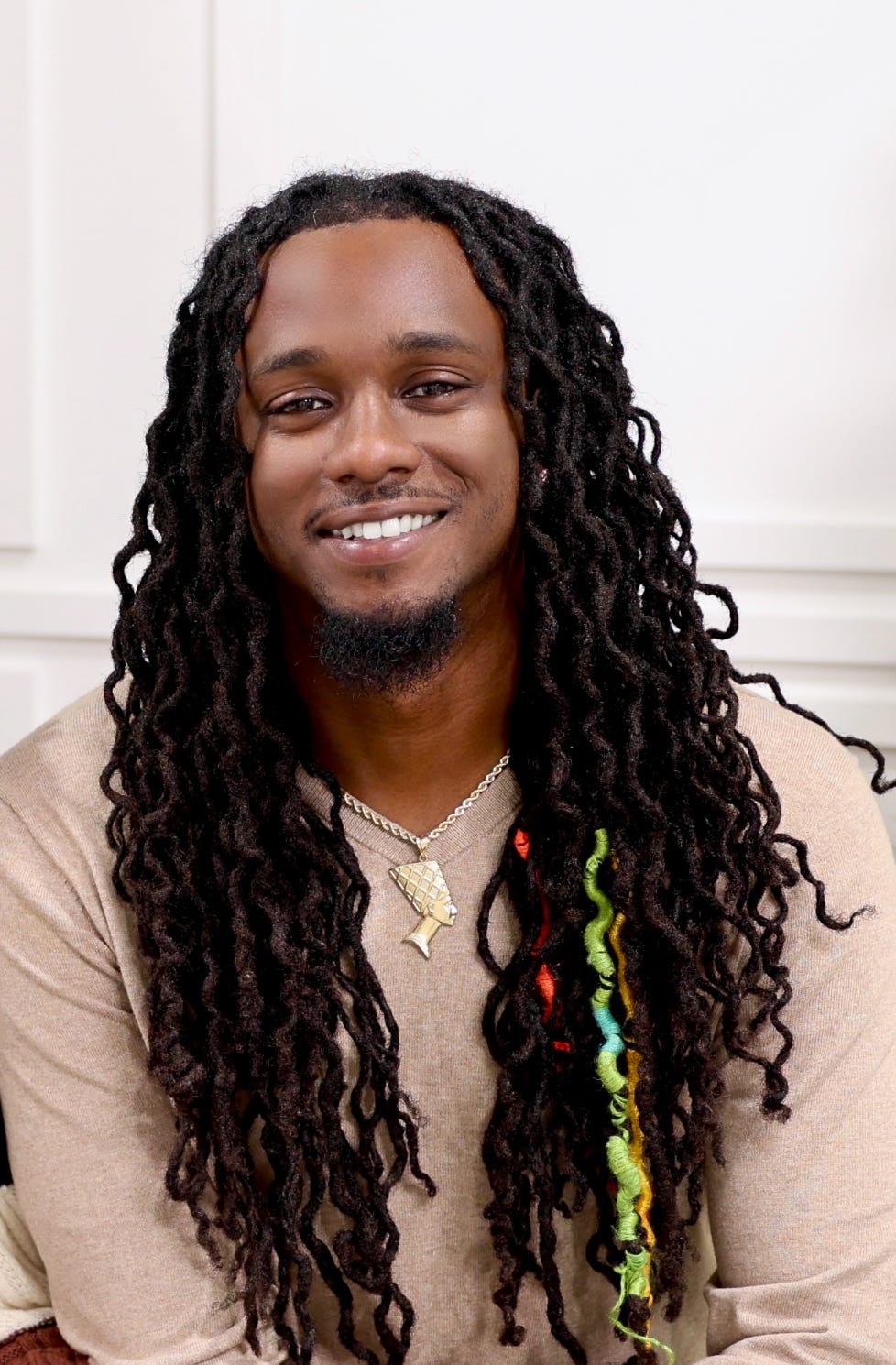
THE ASK: BECOME A PAID SUBSCRIBER
Black male educators are less than 2% of this profession. I am that 2%, and I am fighting alone against the systematic erasure of our histories, our legal protections, and our cultural truth. I’m independent with no corporate sponsor and no safety net; this work lives or dies on the support of this community. When a billionaire can pull an artist off a stage for saying two words, and a Black woman artist with a platform calls that an opinion, the only thing standing between the record and the tarp is somebody who did the reading and refuses to be quiet about it. If every one of you reading this converted to a paid subscriber today, we would stop surviving and start building: a permanent, independent archive of Black expertise with the depth of PBS and the fire of our ancestors, one that no stadium owner and no contract clause can take off the bill. So here is the ask: become a paid subscriber.
RELATED READINGS (bibliography)
Brooks, Daphne A. Liner Notes for the Revolution: The Intellectual Life of Black Feminist Sound. Harvard University Press, 2021.
Feldstein, Ruth. How It Feels to Be Free: Black Women Entertainers and the Civil Rights Movement. Oxford University Press, 2013.
Fischbach, Michael R. Black Power and Palestine: Transnational Countries of Color. Stanford University Press, 2018.
Fischbach, Michael R. The Movement and the Middle East: How the Arab Israeli Conflict Divided the American Left. Stanford University Press, 2019.
Giroux, Henry A. On Critical Pedagogy. Continuum, 2011.
Khalidi, Rashid. The Hundred Years’ War on Palestine. Metropolitan Books, 2020.
Khalidi, Walid, ed. All That Remains: The Palestinian Villages Occupied and Depopulated by Israel in 1948. Institute for Palestine Studies, 1992.
Lubin, Alex. Geographies of Liberation: The Making of an Afro Arab Political Imaginary. University of North Carolina Press, 2014.
Mills, Charles W. The Racial Contract. Cornell University Press, 1997.
Mills, Charles W. “White Ignorance.” In Race and Epistemologies of Ignorance, edited by Shannon Sullivan and Nancy Tuana. SUNY Press, 2007.
Pappé, Ilan. The Ethnic Cleansing of Palestine. Oneworld, 2006.
Redmond, Shana L. Anthem: Social Movements and the Sound of Solidarity in the African Diaspora. NYU Press, 2014.
Redmond, Shana L. Everything Man: The Form and Function of Paul Robeson. Duke University Press, 2020.
Taylor, Keeanga Yamahtta. From #BlackLivesMatter to Black Liberation. Haymarket, 2016.
Wineburg, Sam. Why Learn History (When It’s Already on Your Phone). University of Chicago Press, 2018.


