

I’m going to be telling y’all about the intricacies of policymaking and how politics is nothing but who gets what, when, where, and how.
That definition is not mine. A political scientist named Harold Lasswell put it in the title of a book in 1936, Politics: Who Gets What, When, How, and ninety years later it is still the most honest sentence anybody has ever written about government. Notice what it doesn’t say. It doesn’t say politics is about values. It doesn’t say politics is about the flag or the family or the Founders. It says politics is a distribution problem. Somebody is getting something, somebody is deciding when, somebody is deciding how, and the only question that matters for you and your people is which side of that ledger your name is on.
So when you tell me you don’t do politics, you’re telling me you don’t care about who gets what, when, where, and how. You’re telling me you don’t care if your neighbor good. Do you care if your neighbor good? Is your neighbor good? Do you care?
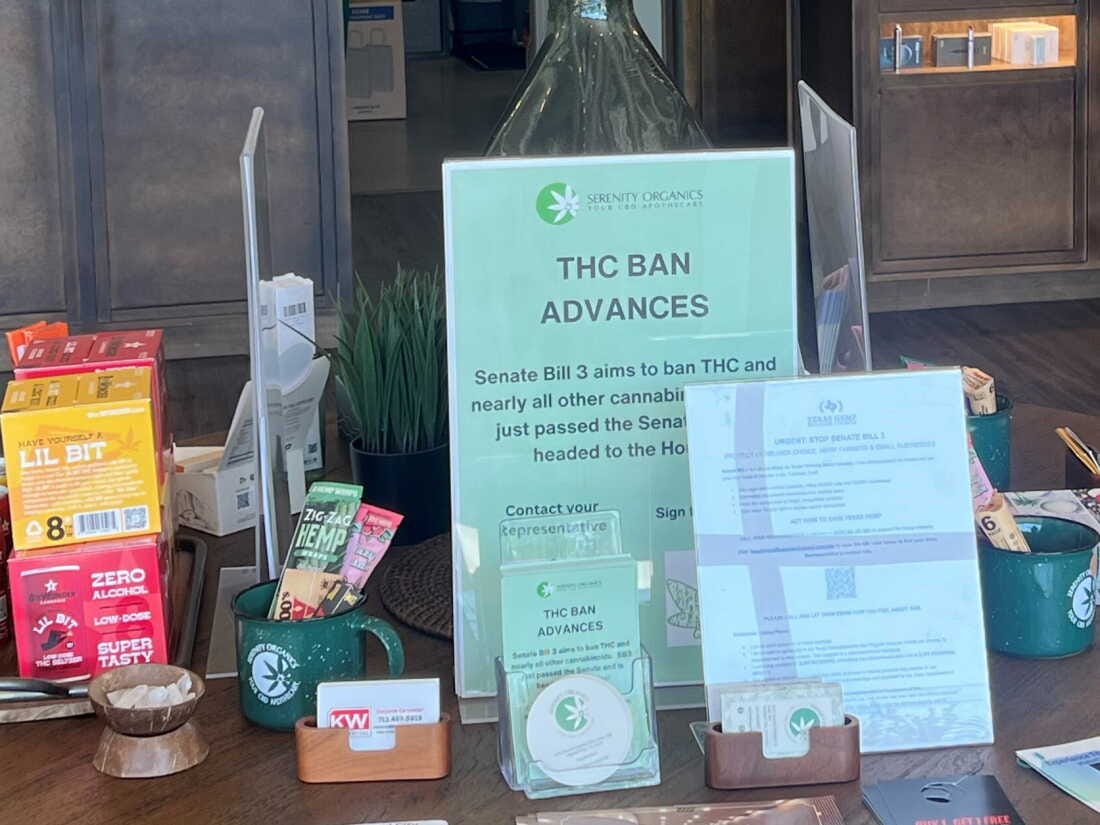
Right now, we’re about to have a conversation about the THC ban in Texas, and I want to start where they always start, with morals, ethics, and public health, because that’s the wrapping paper. A lot of our laws in this country is justified by saying it is about how it can keep us safe, how it is about protecting our unalienable rights, that being life, liberty, and the pursuit of happiness, and saying that the only way you can have your unalienable rights taken away from you is if you infringe upon somebody else’s rights. That’s the Jefferson deal, that’s the civics class version. Then what they’re trying to convince us now is that eating an edible is taking away the unalienable rights of somebody.
The question you should ask yourself is, for whom?
Because in any other instance, if I’m able to pay somebody to get them to do something, it’s called a bribery. In America, it’s called lobbying.
The Receipts: Follow the Money From the Distributor to the Dais
Let me lay the paper on the table, because my motto is facts over feelings, Research over MeSearch.
The hemp derived THC market in Texas grew out of a loophole in the 2019 state law that mirrored the 2018 federal Farm Bill, and by the time the legislature came back in 2025 that loophole had turned into roughly 8,300 retail outlets by the sponsors’ own count, and by the Department of State Health Services’ count today, about 14,000 licensed consumable hemp retailers statewide. Gummies, drinks, vapes, pre rolls, Delta 8, Delta 9, THCA flower, all of it sold in gas stations and smoke shops in every county in Texas. Two specific industries watched that happen and did not like what they saw.
Lieutenant Governor Dan Patrick made Senate Bill 3, a near total ban on consumable hemp derived THC, one of his top priorities for the 2025 session, called the products dangerous, said they were putting Texas children at risk, and courted Republicans in both chambers to pass it. A flyer circulating that spring from the Wholesale Beer Distributors of Texas backed a full ban and cited, in its own words, the need to preserve a level playing field for Texas beer distributors. Read that again. Not a level playing field for Texans. For beer distributors.
Then the money. Texas campaign finance records show John Nau, the beer distribution executive behind Silver Eagle Distributors, one of the largest Anheuser Busch distributors in the country, gave $250,000 to Patrick’s campaign on April 12, 2024. The Beer Alliance of Texas PAC gave $25,000 to Texans for Dan Patrick on December 2, 2024. That is at least $275,000 from a major beer distributor and a beer industry political committee in the run up to the session where Patrick tried to eliminate the beer industry’s fastest growing competitor. Other reviews of his filings put the alcohol, tobacco, and pharmaceutical total higher. Texas Democrats and Vikki Goodwin, the Democratic nominee running against Patrick this November, have been saying the quiet part in press releases all summer.
Now here is where the political literacy comes in, because the transcript version of this story and the paper version of this story diverge on one detail and you need to know the difference so nobody can use it against you. SB 3 passed both chambers. Patrick then spent weeks publicly pressuring Governor Greg Abbott to sign it. Abbott vetoed it at the last minute, on June 22, 2025, just before the deadline that would have let it become law without his signature, and called it likely unconstitutional. That was a major setback for Patrick. But the ban still happened. Abbott issued Executive Order GA 56 in September 2025 directing the health department and the alcohol commission to crack down using authority they already had. Senate Bill 2024 banned cannabinoid vapes that same month. A total THC testing rule that counts THCA took effect March 31, 2026 and cleared smokable flower off the shelves. Then the Texas Supreme Court in May 2026 let the Department of State Health Services reclassify every hemp derived THC except low dose Delta 9 as a Schedule I controlled substance, and that scheduling notice took effect July 31, 2026. A federal judge in Galveston denied the industry’s emergency request on August 10. So on July 30, a small business had a building full of Delta 8, Delta 10, THCP, and THCA flower that was legal inventory, and on July 31 that same building was a felony.
So no, the bill did not “pass” in 2026. Something worse happened. The bill failed, the people won on paper, and then the outcome got delivered anyway through an executive order, an agency rule, and a court. That is the lesson. When you talk about protecting democracy, defending democracy, you have to ask yourself, what are you defending and what are you protecting? We democratically, and I say we loosely, but in Texas we democratically elected Dan Patrick. Dan Patrick is supposed to be going in line that allows for us to democratically vote on certain things. He purposely circumvented the policymaking process at the expense of Texas constituents for big tobacco and big alcohol, man. He don’t care for working class people.
What the Market Actually Said
Capitalist contradictions. These folks taught us that capitalism says the consumers dictate the market. Capitalism says that free market competition is what is good. So let me tell you what the consumers said.
On July 28, 2026 the headlines ran everywhere, and the tabloids ran it loudest, that for the first time more Americans use marijuana daily or nearly daily than drink alcohol or smoke cigarettes at that frequency. The source under the headline is not a tabloid. It is the federal government’s own National Survey on Drug Use and Health, released by SAMHSA in July, and the numbers for 2025 are 21.4 million daily or near daily marijuana users, 19.9 million daily cigarette smokers, and 17.2 million daily or near daily drinkers. Alcohol is still used by more people overall, 129 million past month drinkers against 43.8 million past month marijuana users, so two things can be true. But the daily customer, the customer that pays the bills, has moved. A Carnegie Mellon researcher named Jonathan Caulkins found the crossover with alcohol first in the 2022 data, and found that per capita daily use had gone up fifteen fold since 1992.
If you have consumers that are now starting to buy and consume more THC than tobacco and alcohol, I believe the market has made its choice. When the industry can go and use its money to go against constituents, what are we talking about then in terms of the free market?
Here is the part that should make every libertarian in Texas sick. A lot of people don’t know what socialism and communism is, and they make these very bastardized ideas of what they think it is, and all they’re doing is actually describing capitalism and the current thing we’re in now. They believe that socialism allows for the government to dictate what industries and what businesses is able to have an advantage within the market. Oh shit, capitalism is doing the same thing in America? A state agency picking which intoxicant you’re allowed to buy, at the request of the incumbent intoxicant’s distributors, is not the free market. It is the state as a bouncer for the beer truck.
And then the “will of the people” argument, since Patrick loves to invoke it. When I said on camera that over 70% of Texans want legal marijuana, I was rounding up from real numbers and I’m going to give you the real numbers because Research over MeSearch means correcting yourself in public. The University of Houston Hobby School’s 2025 survey of 1,200 Texans found 62% support legalizing recreational marijuana for adults, 69% support decriminalizing possession, and 79% support medical marijuana, and that medical number includes 75% of Republicans. The UT Texas Politics Project poll from spring 2025 found 84% of registered voters want possession legal under some circumstances and only 15% want it illegal under every circumstance. In the March 2026 Democratic primary, a nonbinding proposition on legalization passed 80 to 20. That 70% I said is the floor for decriminalization and the ceiling is higher.
Now, in the interest of two things being true, that same Hobby School poll found 55% of Texans supported banning the unregulated hemp derived products specifically, and Patrick posted that number the day it came out. He was right that people are uneasy about gas station gummies with no dosing standard. What he did with that unease is the tell. The people said regulate it. He said ban it, and hand the customers back to the distributors who paid for his campaign. Guess which one preserves a level playing field for beer.
The Lieutenant Governor Has More Power Than the Governor, and He Used It
Now, in Education Is Elevation, my goal within this whole production doing a long form is to give what I’m going to call political literacy. I want you to be able to read and write situations pertaining to politics a little bit better when you’re done with dealing with my Black ass. That’s what I say.
So here’s a literacy lesson most Texans never got. The lieutenant governor of Texas has more power in the legislature than the actual governor do. He presides over the Senate, he appoints every committee chair, he decides which bills get a hearing and which bills die in a drawer, and he controls the calendar. The governor can veto and the governor can call special sessions, but the lieutenant governor decides what the Senate even talks about. That is why Dan Patrick could make a THC ban a must pass priority and get it through the Senate, and that is why, when the governor vetoed it, Patrick didn’t have to go home. He could keep working the machinery until the outcome arrived through the back door.
And this is the same Dan Patrick who this summer said that James Talarico, the Democratic nominee for U.S. Senate against Ken Paxton, doesn’t look manly enough to win in Texas. Morning Joe laughed at him on national television. My point in bringing up the way this man is presenting himself is not to clown a 76 year old man’s wardrobe. It’s this: what give him the jurisdiction as lieutenant governor to say how another man presents and if he manly enough? The Texas GOP has spent months calling Talarico low T, calling him a soy boy, putting AI videos of him in a dress on the internet, and Texas Monthly ran a whole piece trying to reverse engineer what a “real Texas man” even is from their insults. Meanwhile the man policing masculinity is the same man who took the beer money and criminalized 14,000 businesses. The masculinity discourse is the smoke. The ledger is the fire.
Who Gets Pulled Over
Now let’s do the part the beer distributors never have to think about. So when it comes to the prison industrial complex here in the great state of Texas, we know Texas runs the largest state prison system in the country by population, we know we host one of the largest concentrations of federal facilities in the country, and we know that there are different contracts that our government has with different services that is not only with private prisons but it’s with public prisons. They still play them games with policy and with contracts.
We have data that says THC legalization brought down the sales of alcohol and tobacco. How did it impact the incarceration rates? That’s the question. So now if I’m riding down the street and you see somebody hit a little vape pen, based off suspicion, you’re able to get pulled over now. Who is more likely to be pulled over on suspicion? The white folks that voted for Dan Patrick who could also eat edibles, or the Black folks that did not vote or did vote?
We don’t have to guess. The ACLU’s 2020 national report found Black people were 3.64 times more likely than white people to be arrested for marijuana possession despite similar use rates, and Texas counties were some of the worst in the country. Texas already gives you up to 180 days and $2,000 for two ounces or less. Now Delta 8, Delta 10, THCP, and THCA flower are Schedule I, and depending on the product and the amount, possession runs from jail time and fines up to a state jail felony. Overnight.
Here’s the moral arithmetic they want you to accept. In this state, it take three DWIs to get a felony. Each DWI you get, you risk killing somebody, because you get drunk and you drive. Every edible you eat, it’s not putting nobody’s life at risk. But this Texas lieutenant governor is saying that the livelihood of everyday Texans on the street that’s driving next to drunk drivers is less detrimental than somebody eating an edible or smoking some weed. And the industry that produces the drunk driver is the one that paid for the ban.
The Morals and Ethics Section, Since They Brought It Up
Let’s go back to the morals and ethics, because Texas Republicans keep telling us that this is about protecting children and that the law is the law.
Ken Paxton’s office, while he was Attorney General of Texas, brokered a plea deal for a Waco lawyer named Adam Hoffman who had been charged with continuous sexual abuse of a child, a first degree felony that carries up to life. After a hung jury in 2025, Paxton’s prosecutors offered a deal that reduced the charges to misdemeanors, proposed one day in jail, and was written so that the admission never specified the victim’s age, which is the exact drafting choice that kept Hoffman off the sex offender registry. A judge pushed it to 30 days, then to 60 after public protest, and Hoffman walked after 30 on good behavior. Snopes and PolitiFact both rated the core claim true. Paxton’s office says the child didn’t want to testify again, and that is a real thing prosecutors weigh. But it was his office’s pen that drafted a plea with no age in it.
So does breaking the law matter or not? And if it matters, does it only matter when you believe a brown immigrant is doing it? Because the same party will criminalize your neighbor, and criminalize the “quote unquote immigrants,” because they say they care about the goddamn law, and then they’ll let the top lawyer in the state write a child abuser a misdemeanor and put him at the top of the ballot for U.S. Senate.
Ain’t no way you telling me you care about kids when you passing out these horrible laws aimed at trans women, who are a fraction of one percent of the population, and telling me it’s about girls’ sports, but then you’re not able to think about it when it comes to these lackadaisical outcomes on a man who abused an eight year old. Pop quiz, Texas. How much are y’all really invested in girls’ sports, and how much do you sensationalize your hatred toward trans people to say you care about women’s sports?
Now, because I’ve been being critical, I want to check myself on air the way I checked myself on camera. I think it is ableist to call Greg Abbott “Governor Hot Wheels,” because you are able to criticize how racist and homophobic this man’s policies are without sensationalizing him being in a wheelchair, and it’s other folks in wheelchairs that are not a piece of shit. I also said some things on camera about how Ken Paxton looks, and I got cockeyed family members I love to death, so I’ll take the ableism note on that too. But Ken Paxton a bad person, though. The policy record does the work. I don’t need his face to do it.
I Don’t Identify as a Democrat
Want to be clear? Me advocating for Vikki Goodwin, for James Talarico, for Gina Hinojosa, and for everybody down the ballot, I don’t identify as a Democrat. I identify as an independent. I identify really as somebody that wants the political, social, and economic independence of Black people, and when I think there are particular issues that I can align myself with that gets me closer to that independence for Black people, I align.
For instance, I think Black folks getting health care is good. I think Black liberation also needs to be explicit about our health care and how much access we have to health care. I don’t think no Democrat or Republican corners the market on how Black people should orient themselves toward health care. I know we need it though. So in Texas, if this Republican or this Democrat can give me the policy specifically for Black folks to get better health care in Texas, I’m getting their health care for Texas, man. And when I disagree with the person that I align myself with on another policy, I’m popping their ass and disagreeing with it. We agree on health care, I think we should have Medicare for All. But we disagree on what you say about, what you say? You say Israel said what about Palestine? You ain’t fucking with that. You see what I’m saying?
This is where I want to bring in Michael Dawson, because Dawson is the political scientist who actually measured what I just described. In Behind the Mule, Dawson found that Black Americans evaluate policy through what he called linked fate, the belief that what happens to Black people as a group shapes what happens to you as an individual, and that we run a “Black utility heuristic,” meaning we use the group’s welfare as a shortcut for our own. That is “do you care if your neighbor good” with a regression table under it. Then in Black Visions, Dawson mapped the actual ideologies inside Black politics, radical egalitarianism, disillusioned liberalism, Black nationalism, Black Marxism, Black feminism, Black conservatism, and showed that none of them is the Democratic Party. The party is a vehicle. The ideology is the driver.
Apply Dawson here. When I say I’m an independent who will vote a Democratic ticket in November, I am not confused and I am not a sellout. I am running the Black utility heuristic on a THC ban that will felonize my cousins, on a health care system that leaves Black Texans uninsured at the highest rates in the country, on a school system that sends Black kids to alternative campuses for a vape pen. The party that gets my vote is the party whose distribution of who gets what lands closer to my neighbor being good. That is not partisanship. That is literacy.
Class Analysis for the Trailer Park and the Hood
It’s the part right here I want to just say this explicitly. I’m leaning forward to say it to all the people watching this. This is the part where you screen record. And this is for my non Black, non left leaning people in Texas, man.
You may have been a lifelong Republican voter. I understand that. You may have been a lifelong conservative. I understand that. However, in this time of day in 2026, you’re not dealing with your grandpa’s Republican Party no more.
That 62% for legalization and that 69% for decriminalization includes lifelong Democrats and lifelong Republicans and lifelong conservatives, because 53% of Texas Republicans told the Hobby School they support recreational legalization and 75% support medical. Dana Loesch, the former NRA spokeswoman, called Patrick’s ban “stupid” on social media and said it was the gun ban argument with a different variable. A hardline conservative lawmaker who voted no said it contradicted the Texas mantra of being pro business, pro farmer, and pro veteran. The blowback came from inside the house.
How many Texas rural Republicans, rednecks that’s in the middle of nowhere Texas, want their farm agriculture land and their business to be in jeopardy because of a data center? Right now I’m making a class analysis, looking up and down and showing you, whether you are poor, whether you are redneck, whether you a Black person, whether you’re from a trailer park, whether you’re from the suburbs, the way that the top is doing us in Texas, they don’t give a damn about us down here. What we seeing is that your papa that been working that land, and they got that land from their grandpa, and their grandpa worked that land, that land being passed to you with clean water and clean air, it won’t matter if Greg Abbott and Dan Patrick can sell you out to data centers. They can sell you out to tobacco and sell you out to alcohol. Politics, who gets what, when, where, and how.
And on the maps. When Donald Trump called down here in the summer of 2025 and said the midterm is about to happen and I need five congressional seats for y’all to take, Texas jumped. The Justice Department’s Harmeet Dhillon sent Abbott and Paxton a letter in July 2025 demanding they dismantle four “coalition districts” where Black and Latino voters together form a majority, and Abbott put redistricting on the special session agenda within days, saying on television it was to make sure the maps “don’t impose coalition districts.” A federal panel, with a Trump appointed judge writing the majority, found “substantial evidence shows that Texas racially gerrymandered the 2025 map” and pointed out that the DOJ letter targeted only majority nonwhite districts and never mentioned a single majority white Democratic district. The Supreme Court let the map stand for 2026 anyway. The state’s own defense in court was, and I’m quoting the state’s brief quoting Hakeem Jeffries, that when Donald Trump says jump, Republicans ask how high, so it couldn’t be about race, it was only about power. Think about that as a legal argument. Our excuse for the racial effect is that we obey the president without question. They got y’all involved in the culture war and they went against federalism. Y’all say y’all against big government, big government called down to Texas, small local government told you to act right, and you complied. You kissed the ring.
Then there’s the word “Anglo”. When I said on camera that Texas legislators talked about sustaining Anglo Texan political power, I want to be precise about the receipt, because precision is a weapon. “Anglo” is not a slur I’m putting in their mouths. It is the official demographic category the State of Texas has used for decades in its own redistricting data and its own court filings, Anglo, Black, Hispanic, and the plaintiffs’ motion in the current case says outright that under this map Latino and Black Texans are deprived of the right to vote on equal terms with Anglo Texans. The state answered that the map was drawn “race blind.” A state that keeps an Anglo column in its own spreadsheets is not race blind. It is race counting, and it is counting toward a result.
Just like a bunch of Democrats believe that Black folks gonna vote for them in overwhelming numbers no matter what, a bunch of Republicans believe the same thing about white folks. It flipped the other way too. It’s a bunch of Republicans that automatically believe that white Texans will vote for them regardless, even if they politically, socially, economically do some shit that is more beneficial to an industry than it is to you.
Historical Context: Texas Has Been Here Before, and It Always Ends on a Black Man’s Sentence
Let me give you the deep history, because Texas didn’t invent this in 2025.
The first city in the United States to ban marijuana was El Paso, Texas, in 1915, and the ordinance was sold explicitly as a way to police Mexican laborers crossing the bridge from Juárez. Texas made it a state crime in 1919. Harry Anslinger’s federal Marihuana Tax Act of 1937 nationalized the Mexican panic, and it took a Texas arrest to bring that law down. Timothy Leary was stopped at the Laredo border in December 1965 with a small amount of marijuana in his car, and in Leary v. United States, decided May 19, 1969, the Supreme Court unanimously struck the Tax Act because its registration scheme forced you to incriminate yourself. Congress replaced it with the Controlled Substances Act of 1970 and Schedule I, which is the same Schedule I the Texas health department just dropped Delta 8 into.
Now here is the Texas receipt that should be in every school. In 1968, Lee Otis Johnson, a Houston SNCC organizer who had led protests at Texas Southern University, was convicted of giving one marijuana cigarette to an undercover officer. One joint. He was sentenced to 30 years. “Free Lee Otis” became a rallying cry across the state, a heckler shouted it at Governor Preston Smith at the University of Houston in 1970 and Smith famously thought the students were shouting “frijoles.” A federal court threw out the conviction in 1972 because pretrial publicity had poisoned the jury, and the very next year, 1973, the Texas Legislature reduced simple possession from a felony that could carry life to a misdemeanor. Texas only reformed its marijuana law after it had to look at what a 30 year sentence for one joint looked like on a Black organizer’s body.
Take that 1973 reform and hold it next to July 31, 2026. Fifty three years later the state moved the felony line back, not through a vote of the legislature, but through an agency rule requested by the beer lobby. Who gets what, when, where, and how.
Then hold the whole thing next to the alcohol industry’s own Texas history, because the three tier system that makes John Nau rich was written in 1935, the year Texas repealed prohibition, and it guarantees by statute that beer must pass through a licensed distributor before it reaches you. The distributor is a creature of the law. Its entire margin is a legal privilege. And local option elections, where Texas counties and precincts vote wet or dry, are still on the books today, which means Texas already trusts local voters to decide alcohol policy. But when Austin, San Marcos, Denton, Elgin, and Killeen voted to decriminalize small amounts of marijuana, Attorney General Ken Paxton sued them in January 2024 to overturn the results. Local control for beer. Preemption for weed.
And underneath all of it is the oldest Texas technology there is. The 1902 poll tax and the white primary, which the Supreme Court had to strike down twice, in Nixon v. Herndon in 1927 and again in Smith v. Allwright in 1944, a case brought out of Houston by a Black dentist named Lonnie Smith with Thurgood Marshall arguing. Texas has always been extremely creative about who gets to be a “we” when “we” vote. The Anglo column in the redistricting spreadsheet is that same creativity with a laptop.
The Pop Quiz Texas Keeps Failing: Political Literacy Was Always a Black Institution
Right now, every ad I see and the message in that ad, sadly, it reflects the bottom tier public education that we have here in Texas. And we have a bunch of double speak. If you have any type of political knowledge in this state, you know that Republicans run this state and have for three decades. It is disingenuous to try to say anything going on in Texas is because of the do nothing Democrats.
But the education section is not about who runs the state. It’s about who gets what, when, where, and how in the schoolhouse, because the THC ban has a school version and it already exists.
House Bill 114 took effect September 1, 2023. It requires Texas public schools to remove any student caught with an e cigarette within 300 feet of campus and place them in a Disciplinary Alternative Education Program, the separate campus that used to be reserved for assault and weapons. Marijuana and THC possession near school is a mandatory DAEP placement too. In the first three months, Houston area districts sent hundreds of kids to DAEP, and by May 2024 it was more than 1,300 across the region’s largest districts, 638 in Cy Fair alone. The average placement was 14 days out of a real classroom. Districts that reported by race showed Black and Hispanic students far outpacing everyone else in referrals, and a retired Texas State professor who spent her career on alternative education, Brenda Scheuermann, said what the research already says: DAEP placement raises a child’s odds of touching the juvenile justice system. HISD reclassified the violation to avoid the mandate. Fort Bend built a prevention program instead. The state built a pipeline.
So here is the school version of the THC ban. The adult gets a felony for a Delta 8 cart. The child gets two weeks in the building where the state keeps the kids it has given up on, for a nicotine vape. Same law, same lobby, same “protect the children” wrapping paper, and the children it protects are never the children it removes.
Now let me bring in Gholdy Muhammad, because I said political literacy is the goal of this whole production, and Muhammad is the education scholar who has already shown that political literacy was a Black invention. In Cultivating Genius, Muhammad goes back to the Black literary societies of the 1800s, the Colored Reading Society of Philadelphia in 1828, the Phoenix Society in New York in 1833, groups of free and formerly enslaved Black people who met to read newspapers aloud, debate resolutions, write petitions, and train each other to argue in public. Elizabeth McHenry documented these societies in Forgotten Readers and showed that for them reading was never a private skill. It was a civic weapon. Muhammad turned that archive into a pedagogy she calls historically responsive literacy, with four pursuits, identity, skills, intellect, and criticality, and criticality is the one that matters here: the capacity to read power, to name who is doing what to whom, and to write back.
Apply Muhammad here. Political literacy is not “learn how a bill becomes a law.” That’s the Schoolhouse Rock version, and the THC ban just proved a bill can fail and the law can still arrive. Political literacy is knowing that the lieutenant governor controls the Senate calendar, that a state agency can schedule a substance without a vote, that a $250,000 check has a date on it and the date matters, and that the same state that mandates DAEP for a vape pen ranks near the bottom of the country on the outcomes that actually feed a kid. The literary societies would have read Dan Patrick’s campaign finance report out loud at the meeting. That’s the curriculum. That’s what Education Is Elevation is for.
And it connects to voting the way it always has. When I was a professor at the University of Oklahoma, the teachers walked out in April 2018, and Governor Mary Fallin compared them to a teenage kid that wants a better car. That same summer, June 26, 2018, Oklahoma voted on State Question 788, medical marijuana. Some school groups had opposed it, worried about kids’ access. It passed with 57% on a primary night turnout that shattered expectations, and Fallin’s own party had to implement it. My point is that voter turnout increased because folks actually like weed, and what we know for Republicans, no matter what state you’re in, high turnout is not good for Republicans. It’s not. If you want to flip Texas, if you want to make it purple, make it pink, you think it’s blue, right now in between now and November you have the ability to put one policy in front of everybody’s face and show how it hit them.
Pulled Over in Prairie View: The Stop Has a Sex and a Zip Code
And I start bringing this to an end like this.
We now live in an age of hyper surveillance. On May 9, 2025, a deputy in the Johnson County Sheriff’s Office, south of Fort Worth, ran a search through Flock Safety’s nationwide license plate reader network. The reason typed in the log was, verbatim, “had an abortion, search for female.” That single query swept 83,000 cameras across 6,809 police networks in every state that shares with Flock, including Washington and Illinois where abortion is legal, with no warrant. When 404 Media broke it, the sheriff and Flock both said it was a welfare check for a missing person and called the reporting clickbait. Then the Electronic Frontier Foundation got the court records. The same day as the search, deputies had opened a “death investigation” into the fetus and were consulting the district attorney about whether they could charge her. She had taken abortion medication at home two weeks earlier. The man who reported her was her partner, who was later charged with domestic violence against her. He had saved the FedEx envelope and the instructions as evidence.
Then Wisconsin. Police in Brown County used Flock to reconstruct a man’s repeated drives across the Menominee River into Michigan, where marijuana is legal, wrote in the criminal complaint that Michigan is “a known source state for marijuana,” and used his lawful travel as probable cause to search his car when he got home. So if a Texas official can use these cameras because he believes a Texas resident went to another state and did something that’s illegal in Texas, you don’t think they’re going to follow you? You went to Colorado and got some gummies and brought your ass back to Texas? At this point they’re showing us their imagination for enforcement. It has no bounds.
Michele Goodwin wrote the book on this before the cameras did. In Policing the Womb, Goodwin documents how the criminalization of pregnancy in America, drug testing of new mothers, fetal endangerment prosecutions, the whole apparatus, was built and tested on Black women first, poor Black women in the crack years, and then expanded outward to everyone once the tools existed. Her argument is that the pregnant body became the state’s laboratory for surveillance, and that the “protect the child” language was the alibi every time. Apply Goodwin here. The Flock search for the woman who had an abortion and the Flock search for the man who bought weed in Michigan are not two stories. They are one tool, and the tool was built the way Goodwin said it would be, on a woman’s body, under the banner of protecting life, and then handed to the narcotics unit.
Now put the THC ban back on the table and look at who is standing on the road when the lights come on. Andrea Ritchie’s Invisible No More is the archive of what the pretext stop does to Black women specifically, and the Texas chapter of that archive has a name. Sandra Bland, pulled over in Prairie View, Waller County, on July 10, 2015, for failing to signal a lane change on her way to a new job at Prairie View A&M, dead in the Waller County jail three days later. The stop was a pretext. It always is. A felony THC schedule multiplies the pretexts. Every “I smelled it” becomes a search, every search becomes a charge, and the charge lands on Black women in ways the beer distributor never has to price in: the mother who loses her kids to CPS over a THC test that Texas hospitals run on Black patients more often than white patients, the woman who loses her housing because a state jail felony is a lease killer, the hemp shop clerk, disproportionately a woman, disproportionately Black or Latina, whose job was legal on July 30 and gone on July 31. The Bexar County Democrats put the number at 14,000 small business owners and more than 50,000 employees. Nobody has published that workforce by race and sex, which means the state has chosen not to count the people it just criminalized. And what you refuse to count, you never have to answer for.
Two things can be true. Unregulated Delta 8 with no potency label is a real public health question, and I’d take that argument seriously from anybody who wasn’t cashing a beer check. But a state that will scan 83,000 cameras for one woman and will not count the race and sex of 50,000 workers it just put out of a job has told you exactly what it values. Who gets what, when, where, and how.
5 KEY TAKEAWAYS
The bill failed and the ban happened anyway. SB 3 passed both chambers in 2025, Abbott vetoed it on June 22, 2025, and the outcome still arrived through Executive Order GA 56, a March 31, 2026 total THC rule, a May 2026 Texas Supreme Court decision, and a July 31, 2026 scheduling notice that made Delta 8, Delta 10, THCP, and THCA flower Schedule I. Political literacy means knowing a law can lose the vote and win the room.
The money has a date on it. $250,000 from Silver Eagle’s John Nau on April 12, 2024, and $25,000 from the Beer Alliance of Texas PAC on December 2, 2024, both landed in Dan Patrick’s committee before the session where he made a ban on beer’s fastest growing competitor a must pass priority, while a beer distributor flyer asked for a “level playing field for Texas beer distributors.”
The market already voted. Federal SAMHSA data for 2025 shows 21.4 million daily or near daily marijuana users against 19.9 million daily cigarette smokers and 17.2 million daily drinkers. A state agency choosing the winner between intoxicants at the incumbent’s request is the thing conservatives claim to hate about socialism.
The enforcement has a zip code and a sex. Black people are 3.64 times more likely to be arrested for marijuana possession at similar use rates, Flock cameras have already been used in Texas to hunt a woman who had an abortion and in Wisconsin to build probable cause from a legal trip to Michigan, and HB 114 already sends Texas children, disproportionately Black and Hispanic, to alternative campuses for a vape pen.
Class is on the ballot. 62% of Texans, including 53% of Republicans, support recreational legalization, and the ban hit rural, suburban, Black, Latino, and white Texans alike. If turnout rises on a policy everyone can feel in their pocket, the only party that loses is the one that took the check.

PAID SUBSCRIBER ASK
I’m fighting to fill a critical void left by the retreat of public education media. Black male educators are less than 2% of this profession. I am that 2%, and I am fighting alone against the systematic erasure of our histories, our legal protections, and our cultural truth. I have no foundation, no corporate sponsor, and no safety net; this work lives or dies on the integrity of this community alone. If every one of you reading this converted to a paid subscriber today, we would stop surviving and start building: a permanent, independent archive of Black expertise with the depth of PBS and the fire of our ancestors. So here is the ask: no shares, no likes, no thoughts. Just a subscription. Fund the fortress or watch the erasure continue. The choice is yours.
RELATED READINGS (Bibliography)
Political thought and the distribution question
Lasswell, Harold D. Politics: Who Gets What, When, How. McGraw Hill, 1936.
Dawson, Michael C. Behind the Mule: Race and Class in African American Politics. Princeton University Press, 1994.
Dawson, Michael C. Black Visions: The Roots of Contemporary African American Political Ideologies. University of Chicago Press, 2001.
Dawson, Michael C. Blacks In and Out of the Left. Harvard University Press, 2013.
Spence, Lester K. Knocking the Hustle: Against the Neoliberal Turn in Black Politics. Punctum Books, 2015.
Taylor, Keeanga Yamahtta. Race for Profit: How Banks and the Real Estate Industry Undermined Black Homeownership. University of North Carolina Press, 2019.
Education and Black literacy tradition
Muhammad, Gholdy. Cultivating Genius: An Equity Framework for Culturally and Historically Responsive Literacy. Scholastic, 2020.
McHenry, Elizabeth. Forgotten Readers: Recovering the Lost History of African American Literary Societies. Duke University Press, 2002.
Morris, Monique W. Pushout: The Criminalization of Black Girls in Schools. The New Press, 2016.
Ma, Haijing, and Ranier Perez. “School personnel’s experiences with implementing Texas House Bill 114 on vaping: A qualitative study.” Health Education Journal, 2025.
Surveillance, reproduction, and policing Black women
Goodwin, Michele. Policing the Womb: Invisible Women and the Criminalization of Motherhood. Cambridge University Press, 2020.
Ritchie, Andrea J. Invisible No More: Police Violence Against Black Women and Women of Color. Beacon Press, 2017.
Roberts, Dorothy. Torn Apart: How the Child Welfare System Destroys Black Families. Basic Books, 2022.
Electronic Frontier Foundation. “Flock Safety and Texas Sheriff Claimed License Plate Search Was for a Missing Person. It Was an Abortion Investigation.” October 2025.
404 Media. “A Texas Cop Searched License Plate Cameras Nationwide for a Woman Who Got an Abortion.” May 2025; and “Cops Used Flock to Track a Man Across State Lines to Create Pretext to Search His Car for Weed.” Summer 2026.
Bonnie, Richard J., and Charles H. Whitebread II. The Marihuana Conviction: A History of Marihuana Prohibition in the United States. University Press of Virginia, 1974.
Campos, Isaac. Home Grown: Marijuana and the Origins of Mexico’s War on Drugs. University of North Carolina Press, 2012.
Leary v. United States, 395 U.S. 6 (1969).
Alexander, Michelle. The New Jim Crow. The New Press, 2010.
ACLU. A Tale of Two Countries: Racially Targeted Arrests in the Era of Marijuana Reform. 2020.


