

Trigger warning for everybody that has experienced sexual violence. We talking about sexual violence for educational purposes only, and I need y’all to take care of yourselves while you read this.
The Group Chat Is the Confession
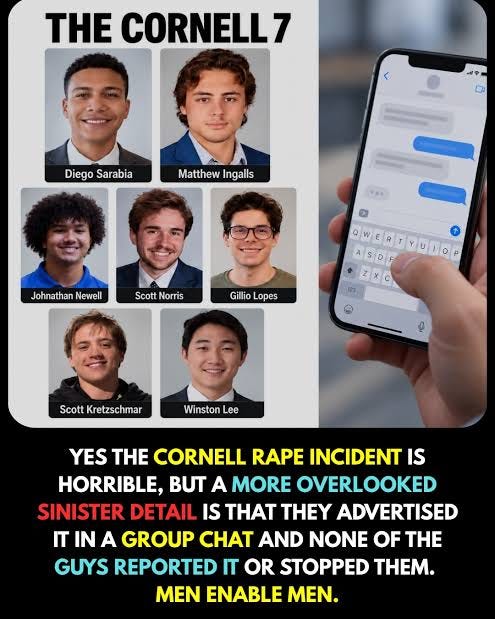
Have y’all heard the news? CBS News New York obtained more messages from the group chat of the seven Cornell men accused of drugging and raping a woman for hours inside the Chi Phi fraternity house, and kinfolks, they are not good. According to the lawsuit, while this young woman was being assaulted, somebody in that chat asked if the “shop” was “still open,” somebody answered yeah with a devil emoji, and somebody else added a yeah of their own, which means that instead of stopping it, grown men with Ivy League student IDs was referring to a human being as a store with its lights on. Just utterly disgusting, awful behavior, and I want to sit in that word for a second, shop, because the language is the evidence, the language tells you exactly how they saw her, not as a classmate, not as somebody’s daughter, not as a person with a future, but as inventory.
Let me give you the receipts, because here at Education Is Elevation it’s Research over MeSearch. The woman, identified as Jane Doe, was 20 years old in October 2024 when she went to the Chi Phi house at Cornell. Her 101 page civil complaint, filed in Manhattan in September 2026, alleges she was pressured into ketamine, marijuana, and alcohol until she was incapacitated, that around 1:42 in the morning one member posted in a Snapchat group called “Chi Phi Actives” that there was free sex upstairs, and that more men came into the room over the next several hours, with the assault ending somewhere around 5:45 that morning. On stream I said seven hours, and the filing actually describes more than four, which don’t make it better, it makes it a timeline.
Crazy how the punishment was the part that went viral. The complaint says Cornell suspended the men, then let some of them “mitigate their conduct” by writing essays, and her lawyer says only two of the seven were expelled. Essays. Somebody’s daughter left that campus and never came back, and some of the men accused of breaking her got a writing assignment. One of the men named in the suit reportedly went on to work at a Wells Fargo branch in Charlotte and was let go only after Tompkins County District Attorney Matthew Van Houten announced on September 28, 2026, that he was reopening the case and taking it to a grand jury. Think about that. If he got a degree from Cornell, he was not out here struggling, he was able to go live his best life for two whole years while she carried it, and the bank didn’t flinch until the cameras did.
Now I want to be precise, because precision is power. No criminal charges have been filed against any of these men, at least two of them deny the allegations through their lawyers, and the civil claims have not been tested in court. Two things can be true. Every man named in that suit is entitled to his day in court, and the institution that let “essays” stand in for accountability is entitled to none of our benefit of the doubt, because the institution already had its day, and it spent it protecting itself.
Born From the Movement, Raised by the General Counsel
To understand how we got here, we gotta go back. Title IX was a major federal civil rights law passed in 1972, signed by Richard Nixon on June 23 of that year, written into being by Representative Patsy Mink of Hawaii, the first woman of color ever elected to Congress, alongside Representative Edith Green, with Senator Birch Bayh carrying it in the Senate. It was modeled after Title VI of the Civil Rights Act of 1964, which means this law is the direct progeny of the civil rights movement and the women’s liberation movement, it is the grandchild of the lunch counter and the consciousness raising circle at the same time.
Most of y’all don’t know the Black women’s history sitting underneath that. On September 3, 1944, Recy Taylor, a 24 year old Black mother, was walking home from church in Abbeville, Alabama, when six white men kidnapped her at gunpoint and raped her. The NAACP sent its best investigator to Abbeville, a young woman named Rosa Parks, and Parks helped build a national campaign around Recy Taylor more than a decade before anybody knew her name from a bus. Two separate all white, all male grand juries refused to indict. Historian Danielle McGuire’s At the Dark End of the Street makes the argument plain: the civil rights movement was, in no small part, a movement against the sexual violence Black women survived, and the Montgomery organizing infrastructure was built by women who had been fighting rape long before they ever fought segregated seating. So when people act like campus sexual assault is a “women’s issue” separate from civil rights, they are erasing the very women who made the civil rights movement possible.
Then came the legal ladder. In Alexander v. Yale (1980), Yale students argued for the first time that sexual harassment was sex discrimination under Title IX, with a young Catharine MacKinnon advising. In Franklin v. Gwinnett County Public Schools (1992), the Supreme Court said students could sue for money damages. In Davis v. Monroe County Board of Education (1999), LaShonda Davis, a fifth grader in Georgia, gave us the rule that schools are liable when they are “deliberately indifferent” to harassment they know about. In 1990, after Jeanne Clery was raped and murdered in her Lehigh University dorm in 1986, Congress passed the Clery Act forcing colleges to report campus crime. Then the 2011 Dear Colleague letter pushed schools to act, the 2017 administration rescinded it, the 2020 rule rewrote the whole process around live hearings and cross examination, the 2024 rule tried to widen protections again, and on January 9, 2025, a federal court in Kentucky vacated the 2024 rule entirely, which put the country right back on the 2020 framework that governs today.
So here’s what I know as somebody with a degree in adult and higher education, as somebody that has been faculty and staff at multiple different universities and different entities and elements. In a lot of these institutions, sadly, the Title IX office that was created for gender equity, for making sure women can participate fully in education, functions in practice to make sure the university is not sued. In too many places, the office only exists to protect the institution from the assailant’s liability, not to protect the student from the assailant. Let me say that again for the folks in the back. It protects the institution from the assailant, not the woman from the assailant.
Cornell’s own numbers tell on it. A student who shared her story on campus said that after she was assaulted her freshman year and reported it, she learned someone else had already reported the same man, and later found out they weren’t the only two. Cornell’s own Presidential Task Force on Campus Sexual Assault, launched after this 2024 incident, reported that a 2025 campus survey found 35% of undergraduate women and 8% of undergraduate men experienced sexual assault during their time at Cornell. An earlier survey cited in The Cornell Daily Sun found only 38% of respondents even knew how to file an official complaint. That is a communication breakdown at best, and at worst it’s a design feature, because what you can’t find, you can’t file, and what you can’t file, can’t be counted against you.
Purple and Gold Probation
Let me get around here real quick, because this is the part that really pissed me off, and I’m only saying it in a humorous way to keep from saying it in a violent way. At LSU, the university’s own Title IX process found a football player responsible for sexual assault and forcible rape. Let me repeat that slowly, the university found him responsible, this ain’t a rumor, this ain’t a TikTok, this is the institution’s own finding. LSU suspended him for a year. He appealed. The university kept the finding of rape and then reversed the suspension, swapping it for two years of “disciplinary probation without restrictions,” which let him right back onto the team. According to reporting from the coverage I was reading, this was a Black woman, and from what’s been reported the young man has not been publicly named, a criminal investigation is open with the East Baton Rouge District Attorney, and no charges have been filed.
So you mean to tell me a university can look at the evidence, say yes, he raped her, and then say, but we need him on Saturdays? That is not discipline, that is a depth chart. We see how the system of white supremacy and capitalism always sides with patriarchy when patriarchy is profitable, and when the profit is a Black man’s body on a football field, the system will even protect a Black man against a Black woman, because in that moment he’s not a man to them, he’s a revenue stream. That’s on Anita Hill and that’s on Clarence Thomas, and I’ll say more about that in another video.
LSU also got a history here that should make all of us uncomfortable, because this ain’t the first time the institution has been caught choosing the program over the victim. The 2021 Husch Blackwell investigation into LSU found years of mishandled sexual misconduct reports involving athletes, and the people who reported it were too often the ones who paid. Same school, same playbook, same tired ending.
Protecting Women From Ghosts While the Wolves Get Scholarships
Now here go the contradiction that I need y’all to sit with. Louisiana, the state where LSU sits, passed its Fairness in Women’s Sports Act in 2022 to “protect women” from trans athletes, and the governor at the time let it become law without even signing it. Louisiana loves to say they want to protect women from trans people in sports. They want to protect women in the category of people they claim are trying to erase them. Hey, listen. A woman was raped at LSU, by the university’s own finding, and they suspended the player and then reinstated him.
I genuinely ask: how do we have more energy for make believe threats to women when it comes to trans people than for the real threats to women when it comes to sexual assault and violence? In December 2024, NCAA President Charlie Baker told the Senate that he knew of fewer than 10 transgender athletes among roughly 510,000 college athletes. Fewer than ten. Then on February 5, 2025, the White House signed an executive order titled “Keeping Men Out of Women’s Sports,” and the NCAA changed its policy the next day. Meanwhile a 35% assault rate for undergraduate women at one Ivy League school produced a task force and a press release. This means the folks running the “protect women” campaign are wrong about where the danger is, and they know it, because if you actually cared about women’s safety you would follow the numbers, and the numbers lead to the frat house, not the locker room.
As men, a lot of us sensationalize trans women in sports because we believe our daughters should never have to play against a trans woman because that’s not fair. Why do you care more about fairness in competitive climates than you care about sending your daughter to a college where she can be raped by somebody in a fraternity? I promise you the Greek system in America has been a breeding ground for sexual violence toward women, white women, Black women, Asian women, Latina women. Go to any big campus, especially the Power Four schools, the ones that is the university of the state, and I guarantee there is a long legacy of women that have been fucked over by the institution because the institution was protecting the same face.
One time, Macy Gray hopped in my comment section and asked me, basically, if y’all gonna protect trans women in the WNBA, what are y’all doing for the real women? My point was, there is no trans woman in the WNBA, but I let it go. Then I had to tell her, the “real women” in the WNBA been telling you what they worried about. They worried about the league not giving them their equitable share of the revenue compared to how the NBA treats its laborers. They worried about the summer of 2025, when men threw sex toys onto WNBA courts in game after game because they thought it was funny to mock women’s sexuality in their own workplace. So right here we have the victimization pattern: instead of dealing with what’s in front of you, you’d much rather deal with hypotheticals. You don’t want to deal with the unethical billionaire, you want to deal with the hypothetical ethical billionaire. You don’t want to deal with the actual sexual assault threat in front of your face, you want to deal with the potentiality of what if a trans woman was in the WNBA. That’s how I know y’all use women’s sports as an aha gotcha moment, and that’s how I know y’all don’t really mean it.
Power Hates a Name Tag
To me, this is all about power. One of the first literature bases that taught me how to understand the power of labeling, the power of going unnamed, and the power of going uncategorized is whiteness studies. Richard Dyer, in his 1997 book White, argued that whiteness secures its power by passing as the default, the unmarked norm, the thing that represents “just people” while everybody else gets a label. Apply Dyer here. Power always wants to go unnamed and unidentified, which is why it has always been treated like a crime, in different ways, to speak truth to power, because the moment you name the thing, you make it visible, and visible power can be held to account.
That’s the whole architecture of rape culture, too. The rapist wants to be “a good kid who made a mistake.” The fraternity wants to be “a brotherhood.” The university wants to be “a community.” Nobody wants to be named. A part of gaslighting is linguistically disarming you, making sure you don’t even have the language to describe what you’re going through, because if you can’t name it, you can’t fight it. That’s the reason Project 2025, in its very foreword, calls for deleting terms like “gender equality,” “diversity, equity, and inclusion,” and “reproductive health” from every federal rule and regulation. That’s the reason they go after books and words and whole fields of study. The fight over vocabulary is a fight over who gets to name the harm.
Think about it like this. When they’re recalling lettuce and garlic and onion powder and baby food and dog food, remember we got food safety law in this country in the first place because, in the early 1900s, Upton Sinclair’s The Jungle exposed what the Chicago meatpacking barons was putting in the can. Congress passed the Pure Food and Drug Act and the Meat Inspection Act on the same day in 1906, the ancestors of today’s FDA, because everybody knew that if a company didn’t have to worry about feeding you rat pellets, and wasn’t regulated for it, they gonna feed you rat pellets. The deregulation agenda flips that. In spring 2025, the USDA withdrew its proposed rule to crack down on salmonella in poultry. Then somebody in my comment section said salmonella is “a personal problem.” A personal problem. It ain’t the problem of the corporations, bro, it’s a personal problem for the people eating it.
Crazy how it’s never a personal problem for the right people. When El Chapo moving weight, they don’t say it’s a personal problem for the fiends. Well, actually they do, depending on who the fiend is. Y’all know the difference between the crack epidemic and the opioid epidemic. The Anti Drug Abuse Act of 1986 punished crack 100 times harsher than powder cocaine, and it took until 2010 to bring that down to 18 to 1, while the opioid crisis got framed as a public health emergency with treatment money attached. One got rehabilitation, the other got criminalization. That’s just what that is.
Same logic with proximity. It blows my mind how rich people can be in proximity to a bunch of thugs and Epsteins and never be seen as an accessory, but when poor people are seen in proximity to a gang, that proximity is an affiliation. My boy Zero once said association brings about simulation: hang out with a fiend, you’ll become a dope fiend. I thought it was just a bar when I was younger, but it’s a theory of power. So if some rinky dink Cornell students and a no name LSU player can get away with sexual violence, what you think the billionaires in the Epstein class get away with? What you think for them?
Mr. Montgomery’s Question and the Statute of Limitations on Somebody’s Soul
Somebody in the chat, Mr. Montgomery, asked me a question, and I’m glad he did, because it brings this whole thing home. He said, iMa bE, “Stopping individual behavior is nigh impossible, there are already laws that should prevent those behaviors, so what further action would you desire be taken against students from two years ago?”
When the Me Too movement went viral in October 2017, a lot of people asked the exact question you asked. What’s the point? Why now? Why you wait so long? Here’s what the record shows: the student journalists at The Cornell Daily Sun been pushing on this case since 2024, the woman reported to campus police within weeks, and her lawyer says police had the Snapchat messages and never followed up, while the district attorney says those messages never reached his office. So the “delay” was not her silence, the delay was the system passing the file around like a hot plate.
My answer is simple. I think that if you rob anybody of their livelihood and their sanity and their peace, then you should go to jail. Even the State of New York agrees that time ain’t an alibi: in 2006 New York eliminated the statute of limitations for first degree rape entirely, and in 2019 it extended the window for second degree rape to 20 years and third degree rape to 10. Two years is not even close to the line. So the legal answer to “why now” is “because the law says now is still on time.”
A lot of us have trouble seeing the humanity in women because it’s like a nebulous woman that exists out there somewhere. So let me make it personal. If your sister or your mother or your auntie was violated by a man, and she tried to get charges brought for two years, and two years later they’re finally brought, do you think those charges are just? I think they would be just. If somebody broke into your house, stole your shit, and robbed your sense of peace, and two years later the police found them, would you feel like two years transpiring means they no longer deserve consequences for robbing you? How is it that our law has more capacity to criminalize an individual for stealing property than for stealing a person’s personhood?
This is where the debate coach in me comes out. Mr. Montgomery’s question presents itself as neutral, just a reasonable question, but claimed neutrality is itself a position. The question plays two roles: what it says is “what’s the remedy,” and what it does is put the burden back on the victim to justify her own pain. That’s exactly why so many women feel discouraged from coming forward, because they will be trivialized this way, asked “so what do you want?” as if wanting accountability is greedy. And this comment fits so ugly poetically into my analysis about whiteness and power, because power is strongest when it goes unnamed, and asking a survivor to justify the timing is just another way of asking her to stop naming it.
What I know as an advocate for women and gender equality is that most sexual assault offenses go unreported. Repeat that: most sexual assault offenses go unreported. Follow it up with another data point that’s not my feelings, it’s the facts: the majority of the men who are reported go uncharged and unconvicted. RAINN’s long cited analysis of federal data estimates that out of every 1,000 sexual assaults, only about 310 are reported to police and only about 25 end with the perpetrator incarcerated. So when we talk about it as an error of judgment, or boys will be boys, or so much time has passed and now he got a family and a career, how does any of that center what happened to her?
The Syllabus Says Consent, the Sanction Says Essay
Let me speak directly to higher education, because this is my field. When a university lets students “mitigate” an alleged gang rape with essays, it is teaching a lesson to every student on that campus, and the lesson is that the conduct code is a writing prompt. Sociologists Jennifer Hirsch and Shamus Khan, in Sexual Citizens (2020), studied Columbia undergraduates and showed that campus assault is shaped by what they call “sexual geographies,” meaning who controls the space, the alcohol, and the door. Apply Hirsch and Khan here. When a fraternity owns the house, supplies the substances, and runs the group chat, the institution has outsourced its most dangerous geography to the people with the least incentive to police it. Peggy Reeves Sanday saw it back in 1990 in Fraternity Gang Rape, after a 1983 incident at the University of Pennsylvania: brotherhood rituals can turn a woman into the shared object through which men prove loyalty to each other. A group chat that says “shop still open” is that ritual with Wi Fi.
Crazy how Cornell is also the birthplace of Alpha Phi Alpha, the first intercollegiate Black Greek letter fraternity, founded on that very campus on December 4, 1906, because Black students were shut out of white social life. Two things can be true: Black Greek life was born from exclusion and has given us leaders and service for over a century, and every Greek organization, ours included, has to answer for hazing, coercion, and the culture of protecting the brother over the person harmed. Accountability can’t be selective, or it ain’t accountability.
Now the policy…. Because a federal court vacated the 2024 Title IX rule in January 2025, campuses are back on the 2020 framework, which requires live hearings with cross examination in higher education and narrows what counts as harassment to conduct that is “severe, pervasive, and objectively offensive.” That means a survivor at Cornell or LSU today can be forced to relive her worst night under questioning by her alleged attacker’s advisor, while the institution calls the process “fair.” Pair that with a Department of Education whose Office for Civil Rights has been gutted by staffing cuts, and you get campuses grading their own homework with nobody checking the grade.
K through 12 is where it starts, though. Davis v. Monroe County was about a fifth grader, LaShonda Davis, which tells you the culture is learned long before freshman orientation. Meanwhile a growing number of states restrict or require opt in permission for sex education, and consent instruction gets swept up in fights over “parental rights,” which means a lot of boys arrive at college with a playbook from porn and a group chat and no vocabulary for consent. If we can mandate standardized testing in third grade, we can mandate consent education in middle school. A child who learns to name consent at 12 is a man who can recognize its absence at 20.
Too Black to Be Believed, Too Woman to Be Protected
This is where intersectionality ain’t optional, it’s the whole analysis. Historian Treva B. Lindsey, in America, Goddam (2022), documents how violence against Black women and girls is both constant and invisible, how Black women are least likely to be believed and most likely to be blamed. Apply Lindsey here. When the LSU case involves a Black woman, she faces a double bind: report a Black man and some folks in our own community call her a traitor feeding the old white myth of the Black rapist, stay silent and the institution gets to pretend nothing happened. Angela Davis named that myth in Women, Race and Class (1981), showing how the lie of the Black rapist was used to justify lynching while the actual rape of Black women by white men went unpunished. Both histories live in that LSU case at the same time.
The receipts on Black women’s credibility go back generations. Joan Little, a Black woman in a North Carolina jail, killed the white jailer who sexually assaulted her in 1974, and she became the first woman in U.S. history acquitted on the defense that she used deadly force to resist sexual assault, in 1975. In October 1991, Anita Hill testified about Clarence Thomas in front of an all white, all male Senate Judiciary Committee, and she got interrogated like a defendant. A month later, 1,603 Black women bought an ad in The New York Times titled “African American Women in Defense of Ourselves.” That’s how we learned to protect ourselves when the institution would not.
The material impacts are real. A survivor who drops out, like Jane Doe did, loses tuition, credits, scholarships, and the earnings premium of a degree, and Black women already carry more student debt than any other group. Survivors with disabilities, especially intellectual disabilities, face sexual assault at rates far above everybody else and get believed even less. Men can be sexually assaulted too, and patriarchy tells them it would make them less of a man to say so, which keeps them silent. Trans women, the very people politicians claim to be protecting women from, reported being sexually assaulted at some point in their lives at a rate of 47% in the 2015 U.S. Transgender Survey. So the people being used as the boogeyman are some of the people most likely to be harmed. Every accusation is a confession.
A Working Definition, Since Somebody Asked
I’m giving you a working definition of rape culture because here at Education Is Elevation, it’s all about giving you the language, the ability to say what you mean and mean what you say. Rape culture is a societal environment where sexual violence is normalized, trivialized, or excused through prevailing attitudes about gender, power, and sexuality. The term came out of the radical feminist organizing of the 1970s, including New York Radical Feminists’ 1974 Rape: The First Sourcebook for Women. Its key characteristics are victim blaming, normalization and trivialization, rape myths, and gender stereotypes.
Victim blaming holds survivors responsible for their assault based on their clothing, behavior, or consumption of alcohol, rather than holding the perpetrator accountable. What did you have on? What time was it? Why was you over there? One of my good friends and mutuals, Raven, a Cornell alum, class of 2020, talked about how it’s understood that women going to frat houses should watch themselves so they don’t get raped, instead of saying rapists shouldn’t rape. We put the onus on the victim. We put it on Black people to not be victims of racism. We put it on women to not be victims of sexism. We put it on gay people to not be victims of homophobia, and on trans people to not be victims of transphobia. Power always wants to pervert the individual that’s calling it out. It wants the perpetrator of the violence to be seen as the victim of the violence.
Then there’s normalization. Think about the casual ways we talk about dominating somebody in sports and competition. “Man, we raped them.” “I’m gonna take your shit.” We even sexualize how we talk about beating people. A lot of people have a hard time coming to grips with the fact that the shit you used to get away with saying to women 15 years ago is not gonna fly now, and it’s the same energy as the folks crying about how they can’t tell racist jokes anymore. Back in your day you could say “go to the kitchen and make me a sandwich” and call it humor. We now live in a time where we are more conscious, we have more literacy, we have more ability to call shit out. So to my fellow dudes: if you violate a woman in 2018 and in 2027 she starts talking about it, you don’t get to be the victim, fam.
Me Too Started With Black Girls, Not Hollywood
Lastly, I don’t want to leave you in the pit, because Afropessimist despair is a description, not a prescription. Tarana Burke built Me Too in 2006 through her work with Black and brown girls who survived sexual violence, more than a decade before the hashtag went viral, and her framework was “empowerment through empathy.” In her memoir Unbound (2021), Burke makes clear the movement was never about destroying men, it was about survivors finding each other and finding language. That’s the counterweight. Before any courtroom gets it right, survivors been building their own institutions of belief: the Black women who organized for Recy Taylor, the 1,603 who signed for Anita Hill, the Cornell Sun students who refused to let this story die.
My granny used to say, if you gonna be a man, you gotta stand in responsibility for your actions. I’d say if you gonna be a good human being, a person of principle, you have to be held accountable for your actions. So why do we act like gender violence against a woman has an expiration date? Look at the dialogue around these women at Cornell and LSU, how they’re being berated, how they’re being chastised, how they’re being forced to relive their trauma, how they got people defending their abuse and justifying their assault, and ask yourself: if a woman was already violated, what would encourage her to bring that person to justice after she’s seen how everybody else gets treated?
See, Sanday reminds us that brotherhood can be built on the shared body of a woman nobody bothered to see as a person, and Lindsey teaches us that the women least likely to be believed have always been the ones building the movements that protect everybody else. Your individual self determination matters, and it will not make you immune from how systems position you. You can be a go getter, you can engage in commerce, you can engage in trade, and the system will still decide whose pain counts. You can want to learn more about sexual assault, more about patriarchy, more about misogyny, more about consent, and still have to fight people who say a man shouldn’t be held accountable for how he violated someone’s consent.
I hope that we can become people that not only knew better, but that do better, and people that want to encourage each other to do better.
BECOME A PAID SUBSCRIBER TODAY
Black male educators are less than 2% of this profession. I am that 2%, and I am fighting alone against the systematic erasure of our histories, our legal protections, and our cultural truth. I’m independent with no corporate sponsor and no safety net; this work lives or dies on the support of this community. If every one of you reading this converted to a paid subscriber today, we would stop surviving and start building a permanent, independent archive of Black expertise with the depth of PBS and the fire of our ancestors. So here is the ask: become a paid subscriber. Fund the fortress or watch the erasure continue; the choice is yours.
Five Key Takeaways
The language is the evidence. Calling a woman a “shop” in a group chat is not a joke, it is a confession of how the men in that chat saw her: as inventory, not a person. Rape culture always shows up in the vocabulary before it shows up in the courtroom.
Title IX was born from the civil rights movement, and Black women built that movement fighting rape. From Recy Taylor in 1944 to Anita Hill in 1991, the women least protected by the law did the most to create it.
The danger to women is in the frat house, not the locker room. The NCAA president counted fewer than 10 trans athletes among roughly 510,000, while one Ivy League survey found 35% of undergraduate women assaulted. Policy energy that ignores that math is politics, not protection.
Two years is not an alibi. New York has no statute of limitations for first degree rape and a 20 year window for second degree. “Why now” is a question the law already answered: now is still on time.
Power hates a name tag. Whiteness, patriarchy, and institutions all keep power by staying unnamed. Naming consent, naming rape culture, and naming the institutions that cover for it is how accountability starts.
Works Cited and Related Readings
Burke, Tarana. Unbound: My Story of Liberation and the Birth of the Me Too Movement. Flatiron Books, 2021.
Crenshaw, Kimberlé. “Mapping the Margins: Intersectionality, Identity Politics, and Violence Against Women of Color.” Stanford Law Review 43, no. 6 (1991).
Davis, Angela Y. Women, Race and Class. Random House, 1981. See “Rape, Racism and the Myth of the Black Rapist.”
Dyer, Richard. White. Routledge, 1997.
Hirsch, Jennifer S., and Shamus Khan. Sexual Citizens: A Landmark Study of Sex, Power, and Assault on Campus. W. W. Norton, 2020.
Lindsey, Treva B. America, Goddam: Violence, Black Women, and the Struggle for Justice. University of California Press, 2022.
McGuire, Danielle L. At the Dark End of the Street: Black Women, Rape, and Resistance. Knopf, 2010.
New York Radical Feminists (Noreen Connell and Cassandra Wilson, eds.). Rape: The First Sourcebook for Women. Plume, 1974.
Sanday, Peggy Reeves. Fraternity Gang Rape: Sex, Brotherhood, and Privilege on Campus. NYU Press, 1990; 2nd ed. 2007.
Sinclair, Upton. The Jungle. Doubleday, 1906.
Law and policy
Title IX of the Education Amendments of 1972, 20 U.S.C. § 1681.
Alexander v. Yale, 631 F.2d 178 (2d Cir. 1980).
Franklin v. Gwinnett County Public Schools, 503 U.S. 60 (1992).
Davis v. Monroe County Board of Education, 526 U.S. 629 (1999).
Jeanne Clery Disclosure of Campus Security Policy and Campus Crime Statistics Act (1990).
Tennessee v. Cardona (E.D. Ky., Jan. 9, 2025), vacating the 2024 Title IX rule.
Executive Order 14201, “Keeping Men Out of Women’s Sports” (Feb. 5, 2025).
Heritage Foundation, Mandate for Leadership: The Conservative Promise (Project 2025), Foreword (2023).
Reporting on this case
PBS NewsHour / AP: Prosecutor reopens probe into Cornell gang rape allegations
NPR via TPR: Prosecutors are reopening a Cornell fraternity rape case
Finger Lakes 1: Lawsuit accuses Cornell, Greek organizations and students
IBTimes: Lawsuit says Chi Phi men could cut penalties with essays
Law Commentary: LSU found football player responsible for rape, reduced suspension
WAFB / Gray News: LSU player accusation prompts criminal investigation


